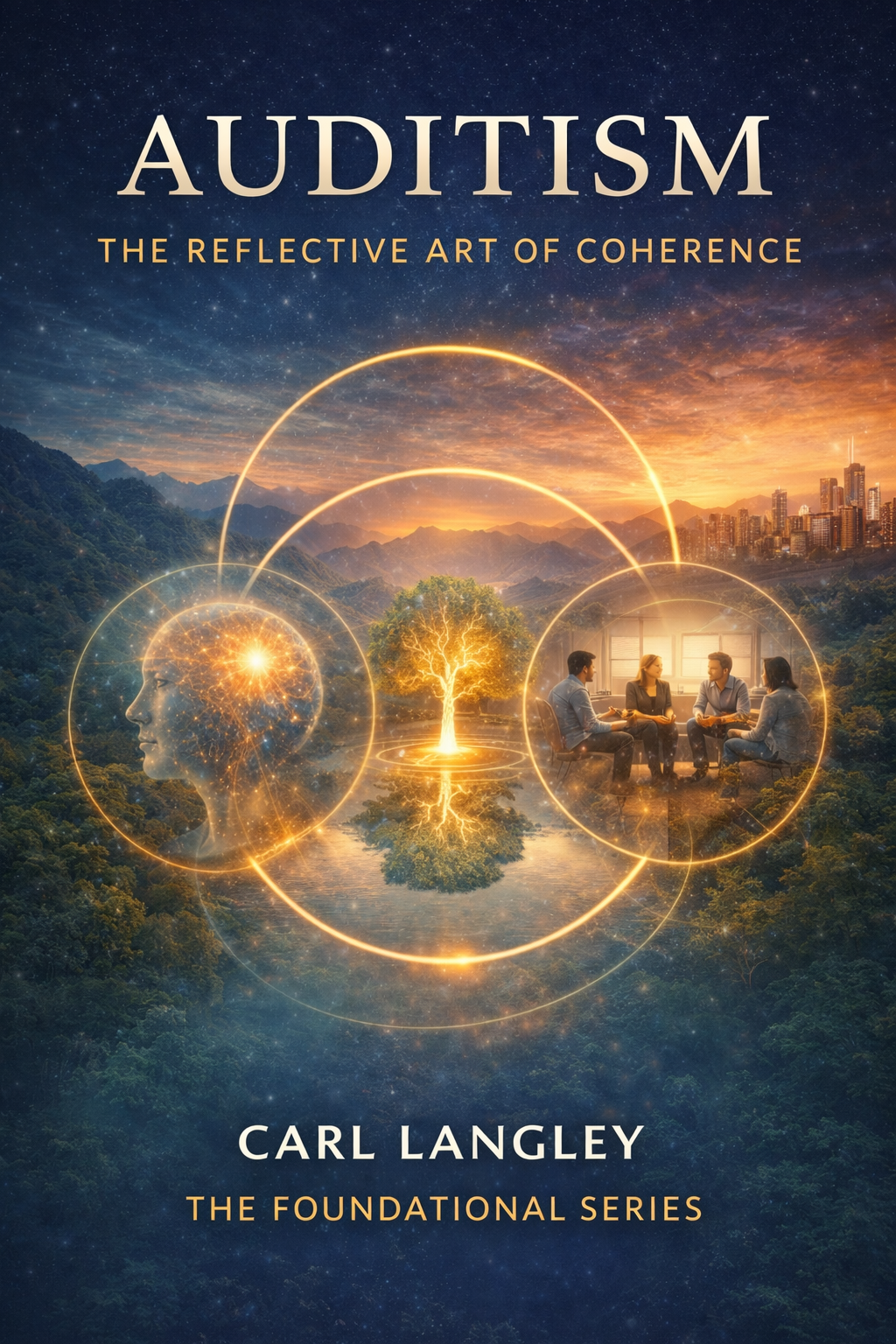
Auditism Book Cover

Auditism: The Reflective Art of Coherence

A disciplined method for seeing, mapping, and stewarding coherence across living fields — without doctrine.

Auditism is a craft of perception: learning to sense what is happening in a field, name it cleanly, and respond with proportion rather than control. It is designed for real conditions — imperfect information, competing narratives, bias, power distortion, and time pressure — where “good intent” is not enough. This volume establishes the core models and ethical constraints that make the method usable across self, relationships, groups, institutions, and society.

What this book helps with

  • Seeing what is actually happening in a situation before reacting or “fixing”
  • Distinguishing pattern from blame (without bypassing responsibility)
  • Working with coherence as a cycle (strain, drift, rupture, repair, renewal) rather than a permanent state
  • Reducing distortion from bias, narrative capture, and premature certainty
  • Acting with proportion: enough intervention to restore workability, not control
  • Holding boundaries, consent, and role clarity as field conditions (not personal attacks)
  • Navigating power and authority without moral theatre or softness-as-avoidance
  • Building durable rhythms of repair and review so coherence becomes culture

Sample Passage


The Auditism series is a body of work concerned with coherence — how living systems sense strain, regulate themselves, repair when necessary, and shape futures without domination or extraction. Auditism is a way of seeing and working with fields: the dynamic contexts formed by relationships, rhythms, structures, and meaning. These fields may be personal, relational, organisational, societal, or ecological. What changes across scales is size and complexity — not underlying structure.

Across the series, coherence is approached as something cultivated, not imposed. Attention is given to timing, restraint, responsibility, and ethical limits, as much as to action and change. The work resists urgency culture, solutionism, and control-based models, favouring perception, stewardship, and design that supports resilience over time.

Each volume in the series is self-contained, offering a complete inquiry into its theme, while also forming part of a wider architecture. Readers may enter the series at any point, depending on context and interest.

Auditism Book Cover

What's inside

  • Auditism as reflective art and applied discipline (method, not doctrine)
  • The Field Ethos: sovereignty, consent, humility, non-coercion
  • Coherence as a living cycle: coherence → drift → recoherence → integration
  • Thriving conditions: rhythm, baseline capacity, recovery, continuity
  • Field literacy: sensing signals, atmospheres, and “what’s really happening”
  • Pattern recognition: loops, incentives, constraints, and coherence drift
  • Mapping practice: turning observation into usable field maps
  • Stewardship design: agreements, boundaries, roles, and culture that holds
  • Resilience over time: maintenance, recalibration, preventing recurrence
  • Proportionate action: timing, restraint, minimum effective intervention
  • Ethical clarity in action: accountability, reversibility, repair without coercion
  • Application across scale: self, relationships, groups, organisations, society
Auditism Book Cover

Sample Passage


Third, this part establishes the ethical posture that makes the method safe and usable. Auditism assumes fallibility. It expects bias, narrative capture, and premature certainty. It therefore treats restraint, consent, proportionality, and corrigibility as core safeguards. Insight does not automatically grant authority. Seeing more does not justify doing more. The deeper the scale and the higher the stakes, the more discipline is required: clearer boundaries, cleaner feedback, stronger consent conditions, and greater humility before consequence.

The Field Audit Methodology is the practical loop that integrates the models: Sense → Map → Reflect → Intervene → Integrate. This is the core discipline of Auditism in action. It is repeatable, scalable, and adaptable across contexts without becoming rigid. It also acts as a brake on impulse: it prevents premature fixing, reduces moralising, and makes interventions more proportionate and less coercive.

Who it’s for
  • Readers who want a clear, repeatable method for making sense of complex situations (not a belief system)
  • Practitioners, facilitators, educators, and coaches working with people, groups, and lived dynamics
  • Leaders and organisers who need accountability and clarity without moral theatre or control-by-force
  • People who care about thriving and resilience — sustaining coherence, not just repairing breakdowns
  • Readers who want an ethical stance built-in: sovereignty, consent, boundaries, proportionality
  • Anyone who wants a scale-aware lens that applies to self → relationship → group → organisation → society

Use Auditism as a calibration manual. Read first for stance and ethics, then practise the method on real fields you’re inside: your own patterns, a relationship, a team, a community context. The aim is not to “win” interpretations — it’s to improve contact with reality, map patterns cleanly, and choose proportionate actions that support thriving and resilience over time. Return to the book whenever urgency, blame, certainty, or control starts to take over your thinking.

  • Compass pass: read the ethos + stance sections first; return when you feel pulled into certainty or coercion
  • Weekly field audit: choose one field per week (self / relational / group) and run: Sense → Map → Reflect → Act → Integrate
  • Thriving design mode: use the stewardship chapters to design agreements, roles, rhythms, and boundaries that prevent drift
  • Difficult conversation prep: use the ethical constraints + pattern maps to reduce blame and improve proportion before you speak
  • Repair and reset: when rupture happens, use the method to restore workability and integrate learning without escalation
  • Study circle: one theme per session; discussion anchored in “what did we observe, and what changed in practice?”

How it connects

What to read next

Auditism: The Reflective Art of Coherence is the anchor volume for your wider Auditism library. It establishes the core stance (field ethos and safeguards), the repeatable method (Sense → Map → Reflect → Intervene → Integrate), and the underlying models of coherence across scale.

Where other volumes go deeper into specific domains (personal clarity, relationships, collective dynamics, societal circuits), this book gives the common language and discipline that keeps the work consistent — so application doesn’t drift into ideology, control, or performance.

  • Auditism — Personal Clarity & Coherence — if you want the method applied inwardly: attention, integrity, self-auditing, stabilisation
  • Auditism — Relational & Family Fields — if you want relationship dynamics: repair, separation, role differentiation, stewardship
  • Auditism — Collective Auditing & Systemic Coherence — if you want groups and organisations: culture, governance, drift, accountability tools
  • Auditism — Society as a Circuit — if you want civic-scale coherence: narrative, feedback, systemic repair and stewardship
Auditism Book Cover

Where to buy this book

Availability details will appear here shortly, including:

Release date

Formats (ebook / paperback / hardback, where applicable)

Where to buy (direct + retailers)

Scroll to Top