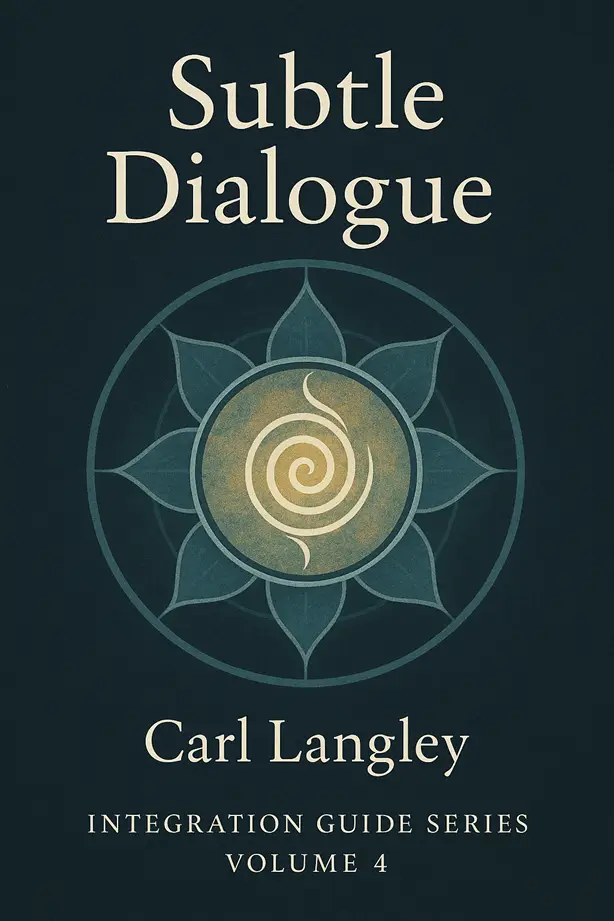
Subtle Dialogue 1

Subtle Dialogue

A practical guide to using imagery, symbol, and altered-state methods as a disciplined way to listen inwardly, run self-audit, and restore coherence — without turning symbols into doctrine.

Subtle Dialogue begins with a simple premise: images, symbols, and inner voices are not only private fantasies, but interfaces — portals through which the local mind meets deeper patterns. Using meditation, guided imagery, trance methods, mantra/voice work, and art-based resonance, this book shows how symbols can function as signals that reshape your inner landscape and strengthen personal, relational, and collective coherence. Designed as a standalone doorway within the Integration Guide Series, it offers step-by-step practices, ethical orientation, and ready-to-use tools (including an imaginal journal template and symbol glossary) so the work becomes lived, not abstract.

What this book helps with

  • Using imagery and symbol as a practical inner listening tool, not vague mysticism.
  • Running self-audit through dialogue: mapping parts, tensions, and hidden motives.
  • Working with dreams, trance, and imaginal states as structured practices for insight and integration.
  • Developing symbol literacy: learning what stabilises you, what distorts you, and why.
  • Creating a repeatable Subtle Dialogue protocol for clarity, regulation, and decision-making.
  • Turning emotional charge into meaningful signal instead of rumination or avoidance.
  • Strengthening discernment and boundaries in inner work (not everything “said inside” is true).
  • Integrating insights into life: journalling, art-based resonance, and weekly review loops.

Sample Passage


Subtle Dialogue begins with a simple premise: that images, symbols, and inner voices are not only personal fantasies, but portals. They are interfaces between the local mind and the wider consciousness field. When approached with care, imagination itself becomes a medium of dialogue — a bridge into deeper coherence.

This volume explores how meditation, guided imagery, hypnosis, and imaginal practices serve as gateways to this dialogue. These practices alter the state of mind in ways that allow symbols to function as signals, resonances that shape and reshape our inner and outer fields. The work here is less about escape and more about alignment: learning how to use imaginal states to harmonise the inner landscape, to refine personal coherence, and to attune relational or collective fields.

Subtle Dialogue 1

What's inside

  • What Subtle Dialogue is — imaginal work as disciplined listening, not fantasy.
  • Entering altered states safely — meditation, trance, and guided imagery as tools for coherence.
  • Symbol as signal — how images carry information, charge, and pattern.
  • Parts and inner voices — mapping sub-personalities, tensions, and hidden motives without drama.
  • Dreamwork and night field — using dreams as data for integration and self-audit.
  • The Subtle Dialogue protocol — step-by-step method: open → evoke → dialogue → test → integrate → close.
  • Discernment and boundary — not every inner message is true; how to test and stabilise.
  • Ethics of suggestion — consent, sovereignty, and safe language in trance facilitation.
  • Mantra, voice, and resonance — using sound to stabilise the imaginal field.
  • Art-based resonance — drawing, writing, and symbolic creation as integration tools.
  • Working with charge — fear, shame, longing, anger: converting emotional intensity into signal.
  • Journals and templates — imaginal journal formats, symbol glossary, and weekly review loops.
Subtle Dialogue 1

Sample Passage


Trance can be described as a shift in consciousness where the usual filters of critical thought soften, allowing imagination, suggestion, and subtle imagery to become more vivid. Hypnosis is a structured form of trance, guided through language, rhythm, and suggestion.

Because trance increases suggestibility, ethical responsibility is paramount. Practitioners must obtain clear consent before guiding trance, use open-ended suggestions that empower sovereignty rather than impose interpretation, and avoid manipulative or coercive techniques. Trance should never override agency — it should open space for the participant’s own resonance to unfold.

In this way, trance becomes a cooperative doorway: reducing noise, strengthening symbolic signal, and supporting coherence without turning imagery into doctrine or the practitioner into an authority over meaning.

Who it’s for
  • Readers who want a structured way to work with imagination for clarity and integration.
  • Practitioners using guided imagery, meditation, or trance who want clean protocols and ethics.
  • People who think in images and symbols and want a disciplined way to translate that into insight.
  • Anyone doing inner work who wants stronger discernment (signal vs story, meaning vs projection).
  • Those wanting to work with dreams, parts, and inner dialogue without getting lost in interpretation.
  • Facilitators and coaches who want repeatable tools for 1–1 work, groups, or reflective exercises.

Start with the protocol and run it simply, with short sessions. Treat symbols as signals to test rather than truths to obey: notice what changes in your body, mood, behaviour, and decisions after a session. Keep a journal, but prioritise integration over interpretation — one actionable adjustment is better than ten meanings. If you facilitate this work with others, begin with consent, pacing, and open-ended language, and close every session cleanly.

  • Solo protocol mode: 15–20 minutes: open → evoke → dialogue → test → integrate → close.
  • Dream capture mode: record dreams on waking, then run a short dialogue with one image or character.
  • Parts mapping mode: write a short “round table” dialogue between two parts, then identify the shared need.
  • Discernment mode: ask: Is this signal, story, or desire? Then test with a small real-world action.
  • Art resonance mode: draw a symbol from the session and write 5 lines: what it protects, what it wants, what it fears.
  • Facilitator mode: guide a short imagery practice using consent + options + permission to stop, followed by grounding and closure.

How it connects

What to read next

Subtle Dialogue sits in your Integration Guides as the imaginal and symbolic pathway into coherence practice. Where Somatic Coherence grounds coherence in body rhythm and regulation, this volume works with image, symbol, inner voice, and altered state as interfaces for self-audit and integration. It keeps the work disciplined: symbols are treated as signals to test, not revelations to obey. In the broader library it complements Auditism (reflective pattern-auditing and repair) and Practicing Coherence (safe delivery and ethical stance), while linking naturally with The Resonant Field (voice/mantra as stabilisers of state) and The Field and the Flow (perception of tone, resonance, and subtle dynamics).

  • Somatic Coherence — for grounding the imaginal work in sensation, breath, and safe regulation.
  • Auditism – The Reflective Art of Coherence — for reflective auditing, pattern detection, boundaries, and repair.
  • Practicing Coherence — for practitioner stance, pacing, and ethical session design when guiding others.
  • The Resonant Field — for sound and voice as coherence levers (mantra, toning, entrainment).
  • The Field and the Flow — for clearer language and perception of resonance in lived environments.
  • The Coherent Mind — for the deeper psychological model behind integration, parts, and recoherence.
Subtle Dialogue

Where to buy this book

Availability details will appear here shortly, including:

Release date

Formats (ebook / paperback / hardback, where applicable)

Where to buy (direct + retailers)

Scroll to Top