Somatic Coherence 1

Somatic Coherence

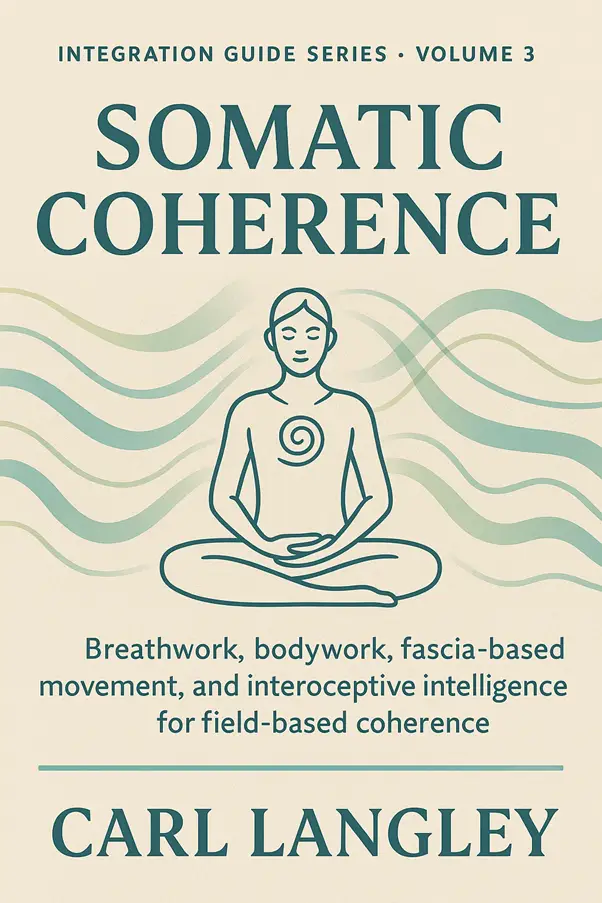
A practical integration guide for tuning the body as a living field — using breath, fascia, movement, and awareness to restore rhythm, regulation, and presence.

The body is not just biology — it is a resonant system where breath, sensation, posture, and attention shape coherence moment by moment. This book gives you grounded practices for real alignment: coherent breathing protocols, fascia-based movement and unwinding, trauma-safe regulation tools, and body–field awareness meditations you can actually use. Expect a clear arc from principles to practice to integration — with daily routines, partner/group options, and reflection tools that help coherence become lived rhythm rather than a concept.

What this book helps with

  • Building body-based regulation: settling stress and restoring steadiness through sensation and breath.
  • Learning coherent breathing patterns that stabilise rhythm and attention.
  • Reconnecting to the body as signal (interoception) rather than noise or threat.
  • Using movement and posture to shift state without overthinking.
  • Working with fascia and tension patterns: unwinding, release, and restoring flow.
  • Increasing grounding and presence in daily life (not just on the mat).
  • Creating daily somatic routines that support resilience and integration.
  • Bringing somatic coherence into relationships and groups: co-regulation, boundaries, and repair.

Sample Passage


The body is more than muscle, bone, and organ. It is a living field — a resonant structure where breath, sensation, and intention intersect with wider currents of energy and awareness. To live somatic coherence is to treat the body not as an object, but as an instrument: both sensor and transmitter within the field of life.

This book explores how coherence expresses through embodiment. Breath, movement, and fascia become not just biological processes but resonant bridges, tuning us to rhythms of clarity, adaptability, and presence. Trauma, posture, and habit are revealed as disruptions in this field — localised entropic patterns that can be met, softened, and reorganised. Through practice, the body remembers its rhythms. Stillness becomes signal. Posture becomes transmission. Awareness becomes resonance.

Somatic Coherence 1

What's inside

  • Somatic coherence defined — body, field, and awareness as one living system.
  • Breath as regulator — coherent breathing patterns for rhythm, calm, and clarity.
  • Interoception and signal literacy — learning the body’s language without fear or over-analysis.
  • Posture and state — how alignment, collapse, and tension shape perception and mood.
  • Fascia and flow — unwinding patterns, release, and restoring movement intelligence.
  • Grounding and gravity — stabilising through contact, weight, and orientation in the body.
  • Movement as recalibration — simple sequences that shift state and restore coherence.
  • Somatic boundaries — sensing “yes/no”, edges, proximity, and energetic hygiene.
  • Co-regulation — how bodies entrain through presence, pacing, and touch-safe practices.
  • Working with intensity — overwhelm, shutdown, agitation, and returning to the window of tolerance.
  • Daily routines — short protocols for morning, midpoint reset, and evening integration.
  • Integration and reflection — tracking patterns, making adjustments, and coherence as lived rhythm.
Somatic Coherence 1

Sample Passage


To understand coherence through a somatic lens is to view the body not as a passive receiver, but as a participatory node in the wider consciousness field. Every posture, sensation, and gesture generates a signal. Every organ system pulses with its own rhythm. The soma is a living antenna, transmitting and receiving data in the language of tone, tension, and flow.

Interoception is the ability to perceive internal bodily states — heart rate, breath, hunger, muscle tension, heat, and subtle shifts in sensation. It is foundational to embodied self-awareness. In field-based practice, interoception becomes a literacy — the capacity to sense fluctuations in coherence, alignment, and energy.

Proprioception gives us a felt sense of body-in-space. It orients us in gravity, enables movement, and maintains balance.

Who it’s for
  • Anyone wanting body-based tools for calm, clarity, and resilience.
  • Readers who feel stuck in their head and want embodiment without performance.
  • People experiencing stress, tension, or overwhelm who want steady regulation practices.
  • Practitioners and facilitators seeking somatic coherence frameworks they can teach safely.
  • Those wanting to understand and unwind habitual tension patterns (posture, fascia, holding).
  • Anyone wanting stronger boundaries and co-regulation skills in relationships and groups.

Start with breath and grounding first. Run the simplest practice daily for a week before adding more. Let sensation be your guide: if a practice increases agitation, reduce intensity, shorten the duration, and return to basic orientation (feet, weight, breath). Use the routines as building blocks — a morning tune, a midday reset, and an evening downshift — then adapt them to your life rather than trying to “do it perfectly”.

  • Daily breath anchor: 5 minutes of coherent breathing, then 60 seconds of stillness.
  • Somatic scan mode: a quick head-to-toe check for tension, heat, numbness, and release points.
  • Grounding reset: feet, weight, slow exhale, orient to the room; repeat until steadier.
  • Fascia unwinding mode: gentle movement and micro-adjustments to let held patterns soften.
  • State shift sequence: breath → posture → movement → stillness (short loop for recalibration).
  • Co-regulation mode: practise pacing, proximity, and presence with another person, then close cleanly.
How it connects

What to read next

Field Hands sits in your Integration Guides as the touch-and-presence pathway into coherence practice. It takes the wider field model and translates it into direct, embodied methods: palm-field sensitivity, self-hand regulation, partner support, session structure, and clean boundaries. In the broader library it complements The Resonant Field (sound as a coherence lever) and Practicing the Field (coherence expressed in communal form), while drawing grounding and ethics from Practicing Coherence and Auditism. In short: it is where coherence becomes contact — not as force, but as attunement, pacing, and repair.

  • Practicing Coherence — for practitioner stance, pacing, session design, and working safely with states.
  • The Resonant Field — for sound-and-frequency methods that pair naturally with touch-based regulation.
  • Practicing the Field — for group formats, ritual structure, and communal coherence containers.
  • Auditism – The Reflective Art of Coherence — for boundaries, repair, and pattern-auditing in relationships and systems.
  • The Coherent Mind — for the deeper psychology of regulation, integration, and recoherence.
  • Thermodynamics of the Mind — for the pressure/entropy/recovery lens that explains why touch can stabilise and why aftercare matters.
Somatic Coherence 1

Where to buy this book

Availability details will appear here shortly, including:

Release date

Formats (ebook / paperback / hardback, where applicable)

Where to buy (direct + retailers)

Scroll to Top