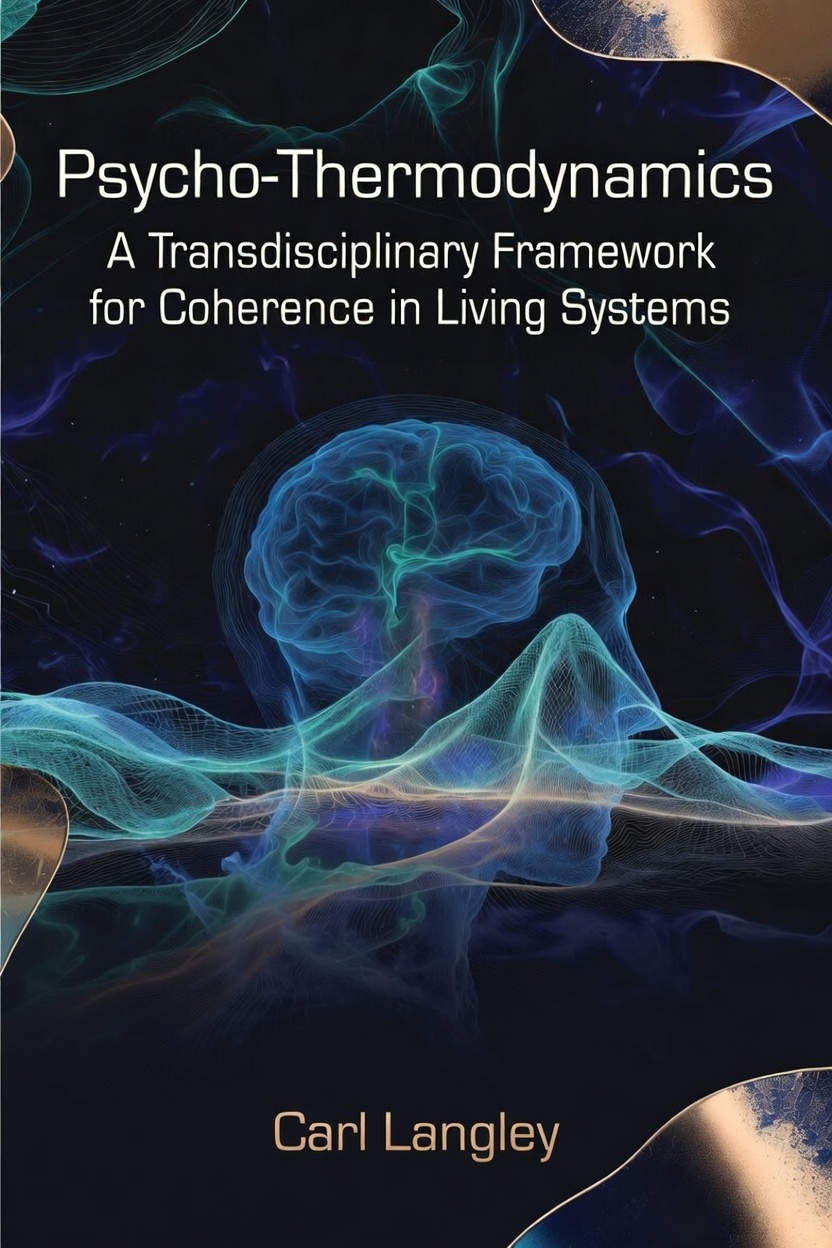
Psycho Thermodynamics Cover

Psycho-Thermodynamics

A transdisciplinary framework for understanding coherence, reorganisation, and living systems across mind, relationship, and field.

“Coherence is not a fixed state — it is a living process.” Human beings are not closed mechanisms but open, history-bearing systems shaped by load, rhythm, fluctuation, meaning, and relationship. Psycho-Thermodynamics describes that reality with structural precision, translating non-equilibrium thermodynamics into a field-based psychological framework for how coherence is generated, lost, and restored across mind, body, relationship, and collective life.

What this book helps with

  • Understanding why breakdown, stuckness, and instability often reflect system dynamics under load rather than personal weakness
  • Recognising how coherence is generated, lost, and restored across mind, body, relationship, and environment
  • Distinguishing first-order stabilisation from second-order reorganisation — and knowing when each is needed
  • Reading phases of organisation more clearly: rigidity, flow, scatter, overload, and higher-order integration
  • Making sense of fluctuation, threshold, and sudden change without reducing experience to symptoms alone
  • Mapping patterns of entropy, dissipation, and repair across personal, relational, and collective life
  • Working with coherence in a non-reductive way through field, rhythm, feedback, and practical intervention
  • Applying a field-based psychological framework to therapy, reflection, research, education, and systems work

Sample Passage


Not all change is the same. Some change stabilises a system within its existing structure: better sleep, cleaner pacing, reduced noise, more honest boundaries. This is first-order work, and it matters. But some change alters the structure itself. A threshold is crossed. T

he previous regime no longer holds. A different organisation becomes possible. This is second-order change. In human life, it may appear as the end of a repeating relational loop, a shift from chronic fragmentation into usable rhythm, or the moment a person stops managing collapse and begins reorganising around truth. 

The question is not simply whether a system is under strain, but what kind of response the strain now demands. Some fields need containment. Others need repair. Others are already asking, however painfully, to become something different.

Psycho Thermodynamics Cover

What's inside

  • Non-equilibrium thermodynamics translated into a human framework for mind, behaviour, and living systems
  • A clear account of coherence, entropy, dissipation, and reorganisation across personal, relational, and collective life
  • The standing-wave-like coherence hypothesis as a candidate control parameter in human systems
  • The Coherence Cycle: stabilisation, destabilisation, and higher-order reorganisation
  • A field-based model of mind that treats the person as an open, history-bearing system rather than a closed mechanism
  • Phase-state logic for reading rigidity, flow, scatter, overload, and integrated high-order states
  • A distinction between first-order stabilisation and second-order change
  • Psycho-thermodynamic registers for tracking phenomenological, physiological, attentional, relational, symbolic, and systemic patterns
  • Field ontology and the wider question of consciousness, participation, and living intelligence
  • Auditism as a practical methodology for sensing, mapping, reflecting on, and working with fields
  • Measurement without reductionism: how to observe coherence without flattening complexity into a single metric
  • Clinical and professional formulations for therapy, education, coaching, supervision, and organisational work
  • Research implications, testable hypotheses, and multi-register protocols for serious inquiry
  • An ethical framework of stewardship, restraint, and non-domination for working with coherence in practice
Psycho Thermodynamics Cover

Sample Passage


A human being is not a closed mechanism moving towards equilibrium. Nor is a relationship, a family, a team, or a culture. Living systems persist only because they remain open to continuous exchange with their surroundings. 

They take in energy, matter, signal, meaning, and relation; they metabolise strain; they export waste, heat, and distortion. This is why equilibrium is not health in a living system. It is the end of process. A coherent life is therefore not a motionless one, but an organised one: a patterned capacity to hold load, recover rhythm, and remain workable under changing conditions. When rhythm breaks, feedback degrades, or reserves are quietly exhausted, the system does not merely “feel bad”. It begins to lose the conditions that made coherent organisation possible in the first place.

Who it’s for
  • Readers who want a rigorous, non-reductive framework for understanding coherence in mind, behaviour, and living systems
  • Therapists, psychologists, coaches, and counsellors working with regulation, breakdown, repair, and change
  • Educators, facilitators, and supervisors who need a clearer language for load, rhythm, and reorganisation
  • Researchers and academically minded readers interested in consciousness, systems, embodiment, and non-equilibrium models
  • Systems thinkers who want a human-scale account of entropy, coherence, fluctuation, and threshold
  • Organisational practitioners, leaders, and consultants working with strain, instability, and adaptation in groups or institutions
  • People who want to understand why life can feel fragmented, stuck, or overloaded without reducing that experience to personal failure
  • Readers drawn to contemplative, integrative, or spiritually informed inquiry who also want conceptual rigour
  • Anyone seeking a serious model of how coherence is generated, lost, and restored across self, relationship, and field

Read it in layers. First, grasp the core grammar — coherence, entropy, load, fluctuation, threshold, and reorganisation — so you can describe what is happening with greater precision and less moralism. Then bring the framework to a real field in your life: your own regulation, a relationship, a workplace, a recurring pattern, or a system under strain. Do not try to apply everything at once. Work with one phase, one register, or one intervention question at a time, and let the model sharpen observation before action. Return to it as both map and method: first for understanding, then for practice, then for deeper reflection as your own sense of pattern becomes clearer.

  • Concept pass: read one chapter at a time to learn the framework’s core architecture — coherence, entropy, phase, threshold, and reorganisation
  • Live-case reading: bring one real issue to the book — overload, stuckness, conflict, collapse, fragmentation, or transition — and read with that field in mind
  • Phase reading: use the model to identify whether a system is rigid, flowing, scattered, overloaded, or reorganising
  • Register mapping: track one issue across the book’s key registers — phenomenological, physiological, attentional, relational, symbolic, and systemic
  • Practitioner lens: use the framework to formulate therapeutic, coaching, educational, or supervisory work in terms of system dynamics rather than identity labels
  • Research lens: read it as a transdisciplinary model and follow the hypotheses, protocols, and measurement questions into deeper inquiry
  • Field audit mode: apply the book to a relationship, team, organisation, or recurring system pattern and ask where coherence is breaking down and how repair might begin
  • Contemplative mode: use the standing-wave, rhythm, and coherence material as a deeper frame for meditation, attention training, and embodied reflective practice
  • Study circle: read one section or chapter per session and organise discussion around pattern, load, repair, and what changes in real life

How it connects

What to read next

Psycho-Thermodynamics sits near the centre of the wider library. It provides the overarching framework that links coherence, entropy, reorganisation, and field conditions across mind, relationship, and living systems. Where The Coherent Mind develops the psychology of lived coherence and Thermodynamics of the Mind explores thermodynamic patterning at the level of mind and behaviour, this book draws those strands together into a wider transdisciplinary architecture.

It connects the psychological, systemic, contemplative, and ontological layers of the work by showing how human systems stabilise, destabilise, and reorganise under real conditions of load, rhythm, fluctuation, and meaning. In that sense, it functions as both synthesis and bridge: tying together the field premise, the thermodynamic grammar, the Coherence Cycle, Auditism, and the broader question of consciousness into one usable model that can move across self → relationship → group → institution → field.

  • The Coherent Mind — if you want the psychology layer in fuller detail: how coherence, fragmentation, and reorganisation are lived in mind, behaviour, and relationship
  • Thermodynamics of the Mind — if you want a more mechanics-forward exploration of load, rhythm, regulation, collapse, and recovery
  • Beyond the Consciousness Field — if you want the wider synthesis that extends the framework across scales and further into the ontological question
  • The Field and the Flow — if you want a more grounded and reflective entry through perception, meaning, being, and becoming
Psycho Thermodynamics Cover

Where to buy this book

Availability details will appear here shortly, including:

Release date

Formats (ebook / paperback / hardback, where applicable)

Where to buy (direct + retailers)

Scroll to Top