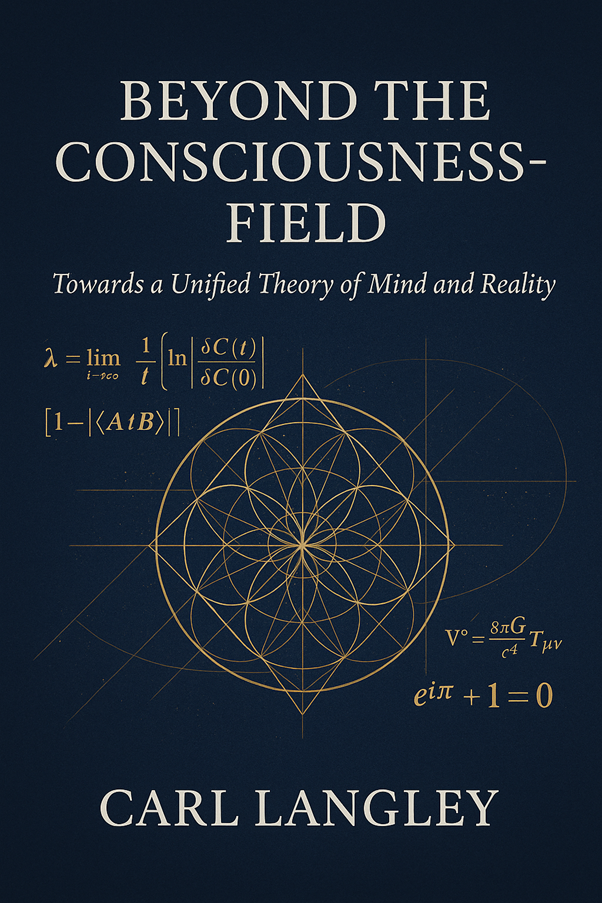
Beyond The Conciousness Field 1

Beyond the Consciousness Field

Towards a Unified Theory of Mind and Reality

Beyond the Consciousness Field is a structured synthesis: an attempt to bridge science and consciousness without collapsing either into belief or reductionism. Across six parts, it builds a unified map of coherence — from foundational field architecture, through thermodynamic and systems dynamics, into applied modelling, ethics, collective circuitry, and the “field beyond form”. The register is deliberately hybrid: clear conceptual scaffolding and formal language (including equations and definitions) sits alongside reflective passages designed to sharpen perception, responsibility, and how you relate to reality across scale.

What this book helps with

  • Building a single coherent map across psychology, systems, and “big picture” ontology
  • Thinking clearly about coherence and entropy in people, groups, and institutions
  • Spotting where “meaning” becomes distortion (and how to re-stabilise)
  • Understanding attention as an energetic/economic driver in modern life
  • Designing more responsible ethics and governance models (without moral theatre)
  • Bridging inner work with outward stewardship (relationships, society, ecology)
  • Holding scientific and contemplative language together without collapse or confusion
  • Developing a disciplined stance towards the speculative: what’s model, what’s metaphor, what’s claim

Sample Passage


This book was written as both inquiry and invitation — an attempt to bridge two languages that have long spoken past one another: science and consciousness. The Unified Field of Everything seeks not to explain the universe as mechanism but to illuminate it as relationship — a continuum of energy, information, and awareness expressing itself through form.

Across its six parts, the work unfolds as a map of coherence. It moves from the foundational architecture of being, through the mechanics of consciousness, into the living field of intelligence that sustains the cosmos. Each chapter translates complexity into clarity, showing that order and beauty are not accidental but essential — the natural language of existence.

This work emerges from earlier manuscripts within the broader field framework — including The Conscious Field Ontology and Psycho-Thermodynamics — and represents their synthesis into one integrative system.

Beyond The Conciousness Field 1

What's inside

  • Holding science and consciousness together as two languages describing one continuum (without collapsing either)
  • Understanding the book’s core triad: energy, information, awareness as three modes of one living reality
  • Learning a hybrid way of knowing: moving between equation, metaphor, and contemplation as complementary registers
  • Using the book as a structured map of coherence across scale, from foundations through to “beyond form”
  • Approaching “field” language with discipline: analogy and correspondence used deliberately as method, not as proof
  • Reading diagrams, equations, and reflections as perceptual tools (mirrors/portals), not as endpoints of certainty
  • Developing a participatory inquiry stance: not observing reality at a distance, but examining how perception participates in it
  • Distinguishing what the book claims and what it doesn’t: interpretive structures for coherence across domains, not predictive instruments
Beyond The Conciousness Field 1

Sample Passage


Earth is a vast resonance system learning through its parts. Humanity, as the conscious cortex of this planetary organism, carries both privilege and duty: to sustain coherence through awareness. When our collective frequency aligns with the planet’s natural harmonics, balance returns — climate stabilises, ecosystems regenerate, and consciousness deepens.

The destiny of civilisation is not domination but synchronisation — to become a harmonic partner in Earth’s song. As each individual learns coherence, the field amplifies; as the field amplifies, the planet awakens.

The Earth is not separate from us — it is us in a wider form.
When humanity becomes coherent, the planet remembers itself as one living light.

Who it’s for
  • Readers who want a serious synthesis that bridges science-language and consciousness-language without forcing either into ideology
  • Systems-minded readers who enjoy large-scale integrative frameworks (foundations → mechanisms → scaling → “beyond form”)
  • People comfortable with hybrid texts: structured theory and definitions, alongside reflective passages that guide perception and inquiry
  • Practitioners and facilitators who want a wider ontological frame for coherence work (and can hold it as a lens, not a dogma)
  • Readers who prefer disciplined speculation: clear distinctions between model, metaphor, and interpretive method
  • Existing readers of your field/coherence material who want the synthesis volume that gathers the strands into one arc
  • Concept pass: read one Part per week to learn the overall architecture (orientation over detail)
  • Method pass: for each chapter, note what register you’re in — model / metaphor / meditation — and what that register is doing
  • Inquiry pass: treat the text as participatory: track how your perception and assumptions shift as you read, rather than hunting for “final answers”
  • Diagram + equation pass: revisit key figures/equations as sense-making tools — write your own plain-language paraphrase of what each is attempting to express
  • Appendix pass: use the appendices to tighten terms: definitions, formalism, maps/mandalas, and the glossary/lexicon — then return to the relevant chapters with clearer footing
  • Part-by-part orientation: read one Part per week to learn the overall architecture before going deep
  • Register tracking: as you read, label each section Model / Metaphor / Meditation and note what it’s doing (definition, insight, calibration)
  • Inquiry journal: keep a running page of “assumptions I brought / assumptions revised / questions that sharpened”
  • Diagram & equation revisit: return to key figures/equations and write your own plain-language paraphrase of what each is expressing
  • Appendix-first clarity: start with definitions/lexicon/formalism, then re-read the chapters with firmer footing
  • Slow-read contemplative pass: one chapter at a time, with pauses for reflection rather than speed or completion
  • Synthesis mapping: draw a one-page map of the six parts and update it as your understanding stabilises

How it connects

What to read next

Beyond the Consciousness Field is the synthesis layer of the library: it gathers the foundational field framing, coherence dynamics, and the method of disciplined inquiry into a single six-part architecture.

Where other books can be entered through a specific doorway (perception and meaning, psychology and regulation, or applied coherence mechanics), this volume steps back to present the whole map — moving from definitions and first principles, through modelling language and formalism, and out into the widest frame of “field beyond form”.

It is best read as an integrative reference: a way to situate the rest of the work inside one coherent structure.

  • The Field and the Flow — a grounded entry via perception, meaning, and becoming
  • The Coherent Mind — field-based psychology: regulation, identity, lived coherence
  • Thermodynamics of the Mind — coherence mechanics: stability, collapse, recovery, integration
Beyond The Conciousness Field 1

Where to buy this book

Availability details will appear here shortly, including:

Release date

Formats (ebook / paperback / hardback, where applicable)

Where to buy (direct + retailers)

Scroll to Top