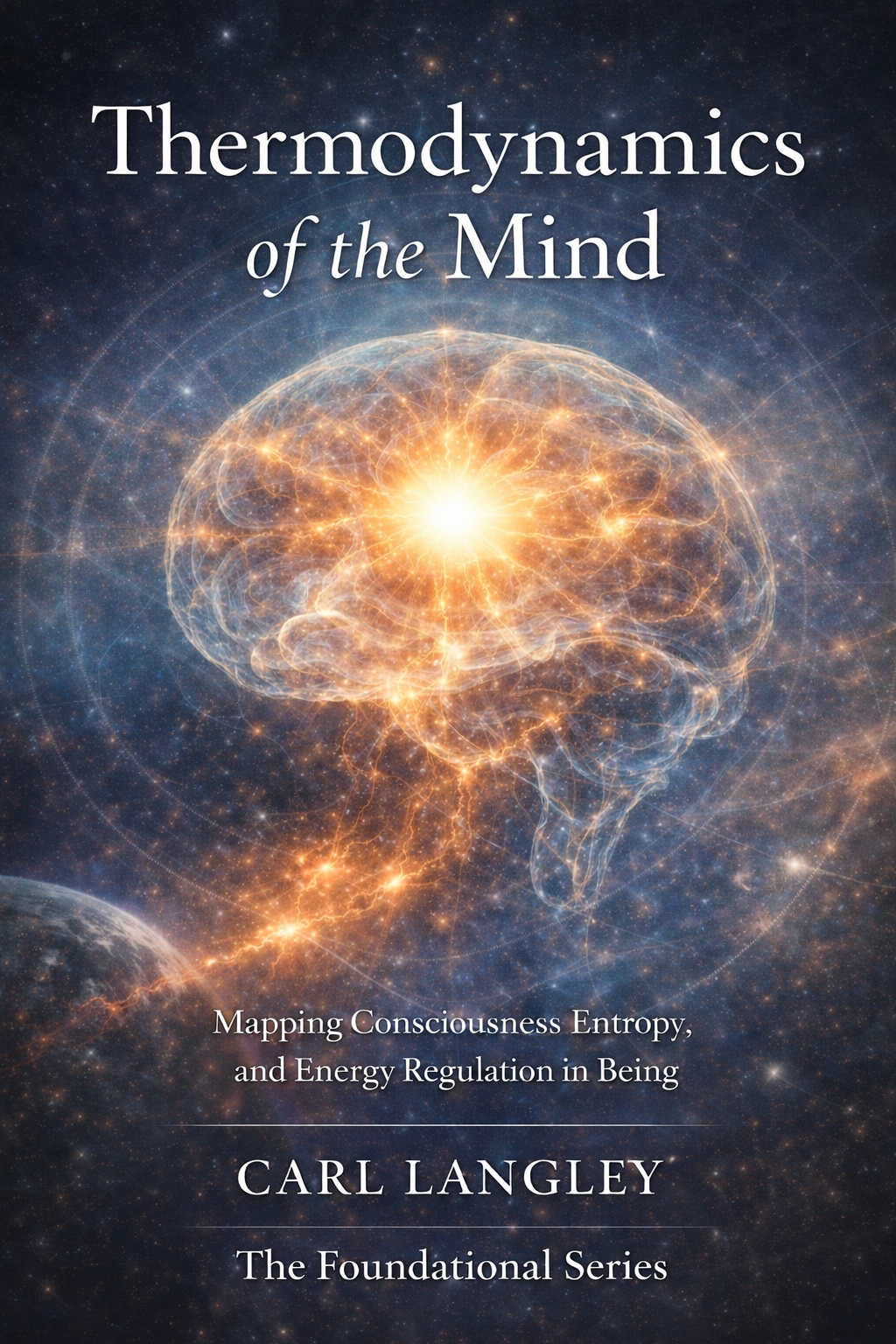
Thermodynamics Of The Mind Cover

Thermodynamics of the Mind

A psycho-thermodynamic framework for understanding coherence, entropy, and rhythm across mind, life, and systems.

“Coherence is not perfection — it is rhythm.” The self is not a static object, but a living organisation: a pattern of attention, sensation, memory, emotion, meaning, and environment held in temporary stability. This book describes that reality with structural precision, translating thermodynamics — energy flow, constraint, and entropy — into a practical lens for how coherence forms, fragments, reorganises, and matures across individuals, relationships, and systems.

What this book helps with

  • Understanding why “mental health” often behaves like a systems problem (load, rhythm, capacity, environment) rather than a personal flaw
  • Recognising the difference between coherence, compensation, and collapse — and spotting early drift signals
  • Mapping stress and overwhelm in thermodynamic terms: inputs, constraints, bottlenecks, and entropy
  • Restoring stability through rhythm and regulation (sleep, pacing, recovery, attention hygiene)
  • Making cleaner decisions by separating state effects from accurate perception and meaning
  • Working with emotion as energy-in-motion (signal, charge, discharge, integration)
  • Understanding relational dynamics as coupled systems (entrainment, amplification, stabilisation, depletion)
  • Turning insight into repeatable practice: stabilise → clarify → intervene → integrate

Sample Passage


“Coherence is not perfection — it is rhythm.”

The self is not a static object. It is a living organisation: a pattern of attention, sensation, memory, emotion, meaning, and environment held in temporary stability. That stability can intensify, soften, fragment, reorganise, and mature. It can become noisy or clear. It can freeze, flow, scatter, or ignite. And it can learn to regulate the conditions under which coherence becomes possible.

Thermodynamics is the study of energy: how it moves, transforms, accumulates, dissipates, and organises systems. Its deeper relevance is universal: thermodynamics describes how any system behaves under constraint — and how order and disorder emerge through the flow of energy.

Human beings are systems. So are relationships. So are organisations, cultures, and civilisations. The world you experience is not only a set of beliefs; it is a set of energetic conditions. When those conditions change, your mind changes with them — often more faithfully than your narratives admit.

Thermodynamics Of The Mind Cover

What's inside

  • Readers who want a disciplined, non-dogmatic model of mind as a living system
  • Practitioners (coaching, counselling, facilitation, education) who work with stress, change, and integration
  • People who feel overloaded or fragmented and want structure, language, and method (not motivational advice)
  • Systems thinkers who want a human-scale way to understand capacity, constraints, and drift
  • Leaders and organisers working in high-load environments who need rhythm, recovery, and sustainability
  • Anyone who wants to apply coherence thinking across scale: self → relationships → groups → institutions
  • Attention economics: inputs, bandwidth, saturation, attentional hygiene
  • Meaning and narrative as thermodynamic organisers (or distorters)
  • Relational coupling: entrainment, amplification, stabilisation, depletion
  • Collapse modes: shutdown, compulsion, fragmentation, false coherence
  • Recoherence methods: minimum effective change, ecological redesign, practice
  • Practical integration: applying the framework to life, work, and systems
Thermodynamics Of The Mind Cover

Sample Passage


This book uses thermodynamic language as a descriptive grammar, not a moral narrative.

Entropy refers to rising disorder, noise, dispersion, friction, and loss of usable work within a system. Negentropy refers to order-making: the local generation or restoration of structure, signal integrity, rhythm, and capacity. Coherence refers to integrated function: alignment across layers of a system such that energy and information move without excessive loss or distortion.

None of these terms are inherently “good” or “bad”. They become good or bad only relative to context, aim, ethics, and consequence. Entropy is not treated here as a villain; it is treated as a property of systems. Likewise, negentropy is not treated as purity or salvation; it is a function — a local tendency towards ordering that is always purchased at a cost and always maintained through ongoing regulation.

The aim is clarity: to provide a language capable of describing what is happening, and a set of methods capable of changing what is happening, with integrity.

Who it’s for
  • Readers who want a disciplined, non-dogmatic model of mind as a living system
  • Practitioners (coaching, counselling, facilitation, education) who work with stress, change, and integration
  • People who feel overloaded or fragmented and want structure, language, and method (not motivational advice)
  • Systems thinkers who want a human-scale way to understand capacity, constraints, and drift
  • Leaders and organisers working in high-load environments who need rhythm, recovery, and sustainability
  • Anyone who wants to apply coherence thinking across scale: self → relationships → groups → institutions

Read it in passes. First, learn the core grammar (coherence, entropy, constraint, rhythm) so you can describe what is happening without moralising it. Then apply the framework to a real situation you’re living: your energy budget, attention inputs, emotional charge, relational coupling, or work-system load. Make one change at a time, track the effects, and consolidate what works — because thermodynamics rewards repetition, not intensity.

  • Concept pass: one chapter per week to learn the model’s architecture
  • Live-case reading: choose one current issue (overload, conflict, fatigue, compulsions) and read with it in mind
  • Energy audit: map inputs, drains, bottlenecks, and recovery sources; adjust one variable for 7 days
  • Rhythm protocol: run a pacing + recovery routine (sleep, breaks, breath, walks) and track coherence markers
  • Practitioner lens: use chapters to frame sessions and debrief change as “system dynamics” rather than identity
  • Study circle: one theme per session, anchored in “what changed in behaviour and capacity?”

How it connects

What to read next

The Coherent Mind sits as the psychology layer of your wider library. It takes the “field” premise and applies it at human scale: consciousness as embodied, relational, and shaped by conditions — with coherence understood as something that forms, drifts, and returns through practice, environment, and relationship.

Where other books may enter through perception/meaning or through thermodynamic mechanics, this one centres the lived interface: how mind actually functions day-to-day, and how coherent change consolidates across self → relationship → group → environment.

  • The Field and the Flow — if you want a grounded entry through perception, meaning, and becoming
  • Thermodynamics of the Mind — if you want a more mechanics-forward lens on coherence, stability, collapse, and recovery
  • Beyond the Consciousness Field — if you want the synthesis volume that expands the framework across scales and into the wider ontology
Thermodynamics Of The Mind Cover

Where to buy this book

Availability details will appear here shortly, including:

Release date

Formats (ebook / paperback / hardback, where applicable)

Where to buy (direct + retailers)

Scroll to Top