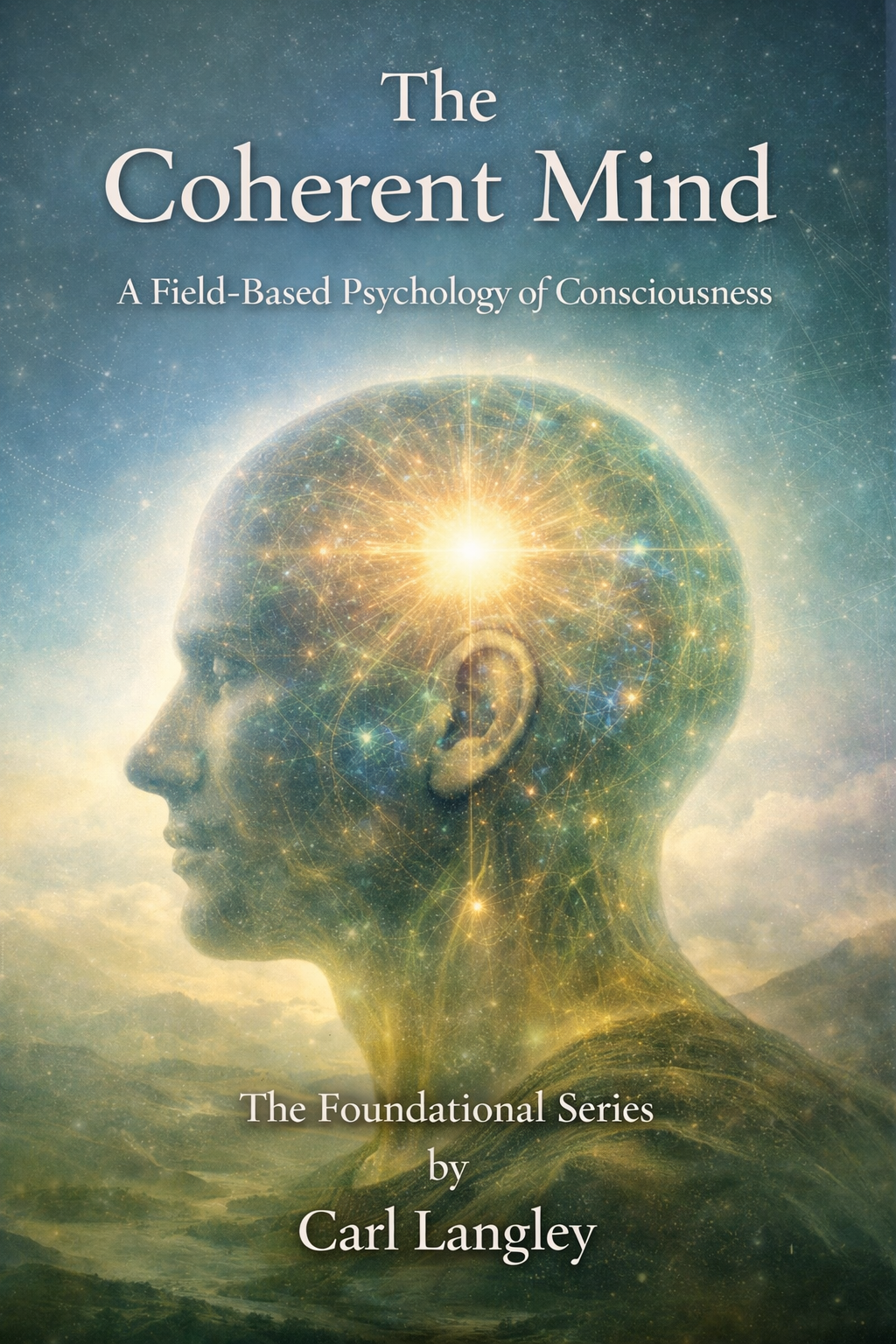
The Coherent Mind Cover

The Coherent Mind

A field-based psychology for understanding mind, meaning, and coherence across scale.

The Coherent Mind reframes psychology as fieldwork: mind is not a sealed unit inside the skull, but a living process shaped by body, relationship, environment, and attention. The book offers a clear framework for how coherence forms, drifts, and returns — within individuals and across the fields they participate in — without reducing experience to slogans or belief. It is designed to be read and used: conceptually rigorous, practically oriented, and scale-aware.

What this book helps with

  • Readers who want a field-based psychology of consciousness that stays disciplined and non-dogmatic
  • Practitioners (counselling, coaching, facilitation, education) who need a clear framework for working with mind in context
  • People who are reflective and pattern-oriented, and want language for coherence, drift, and return
  • Those navigating complexity across self → relationships → groups, and wanting a scale-aware lens
  • Anyone who prefers method over motivation and practical integration over performance
  • Readers exploring “field” language who want it framed as context-of-influence, not mystique
  • Working with emotion as information-in-motion (somatic patterning, not personal failure)
  • Strengthening relationships through boundaries, reciprocity, attunement, and repair
  • Applying coherence thinking across scale: self → relationship → group → environment
  • Translating insight into practice through repeatable methods: calibration, reflection, integration

Sample Passage


Endogenous and exogenous fields do not sit side-by-side like separate worlds. They couple. They affect each other continuously, and the self is where that coupling becomes experience.

You can think of the mind as a living tuning system:

The endogenous field sets sensitivity and interpretive bias — what can be tolerated, what is amplified, what is filtered out.

The exogenous field supplies conditions and inputs — relational climates, environments, information streams, symbolic atmospheres.

Coherence is what happens when coupling becomes organised enough that perception is accurate, choice is available, and the system can metabolise experience without fragmentation.

Entrainment: how the outside gets inside
Living systems entrain. Rhythm meets rhythm, and patterns synchronise.

A calm nervous system can settle a room.
A charged room can destabilise a sensitive system.
A coherent relationship can regulate what the individual cannot regulate alone.

The Coherent Mind Cover

What's inside

  • Field-based psychology: mind as contextual, relational, and embodied
  • Endogenous and exogenous fields (inner state ↔ outer conditions)
  • Coherence, drift, decoherence, recoherence (the core cycle)
  • Attention and perception as field processes (signal, bias, filtering)
  • Meaning-making: narrative, interpretation, and “story gravity”
  • Emotion as carrier wave (somatic resonance and behavioural transmission)
  • Regulation and rhythm (capacity, pacing, recovery, consolidation)
  • Trauma and coherence injury (collapse patterns and repair conditions)
  • Polarity integration (light/dark balance without splitting or bypass)
  • Relational fields (reciprocity, boundaries, repair, attunement)
  • Group and collective dynamics (entrainment, culture, coherence drift)
  • Applied methods and practices (calibration, reflection, integration routines)
The Coherent Mind Cover

Sample Passage


A field-based psychology treats information not as abstract “data”, but as a patterning force. It shapes nervous system state. It shapes expectation. It shapes what you can notice. It shapes what you can tolerate.

This is why “what you consume” is not a lifestyle tip. It is signal governance.

Information is not neutral

Information always arrives with tone. It carries affective charge and implicit values. Even “facts” land in a nervous system. They either widen perception or recruit threat.

A disciplined mind learns to ask:

What does this input do to my signal integrity?

Does it increase clarity or increase noise?

Does it widen capacity or narrow it?

Does it help me govern myself — or does it hijack me?

Does it invite truth — or does it rehearse reaction?

This is not censorship. It is stewardship.

Who it’s for
  • Readers who want a field-based psychology of consciousness that stays disciplined and non-dogmatic
  • Practitioners (counselling, coaching, facilitation, education) who need a clear framework for working with mind in context
  • People who are reflective and pattern-oriented, and want language for coherence, drift, and return
  • Those navigating complexity across self → relationships → groups, and wanting a scale-aware lens
  • Anyone who prefers method over motivation and practical integration over performance
  • Readers exploring “field” language who want it framed as context-of-influence, not mystique

Read it in passes. First, take the architecture: what “field” means here, how coherence and drift work, and why state and context matter. Then return to the chapters that match your current edge — attention, emotion, boundaries, group dynamics — and apply one small change at a time. Treat the practices as calibration tools: short, repeatable, and designed to consolidate insight into lived behaviour.

  • Orientation pass: one chapter per week to learn the framework without rushing for completion
  • State-first reading: choose a live theme (attention, emotion, boundaries, overload) and read with it in mind
  • Calibration practice: run one practice or routine for 7 days; track what changes in perception and behaviour
  • Reflection journal: keep a simple log: signal / state / story / next action / integration note
  • Practitioner lens: use chapter themes to frame sessions (without imposing conclusions), then debrief outcomes
  • Study circle: one cluster per session, anchored in “what changed in real life?” rather than theory-only discussion

How it connects

What to read next

The Coherent Mind sits as the psychology layer of your wider library. It takes the “field” premise and applies it at human scale: consciousness as embodied, relational, and shaped by conditions — with coherence understood as something that forms, drifts, and returns through practice, environment, and relationship.

Where other books may enter through perception/meaning or through thermodynamic mechanics, this one centres the lived interface: how mind actually functions day-to-day, and how coherent change consolidates across self → relationship → group → environment.

  • The Field and the Flow — if you want a grounded entry through perception, meaning, and becoming
  • Thermodynamics of the Mind — if you want a more mechanics-forward lens on coherence, stability, collapse, and recovery
  • Beyond the Consciousness Field — if you want the synthesis volume that expands the framework across scales and into the wider ontology
The Coherent Mind Cover

Where to buy this book

Availability details will appear here shortly, including:

Release date

Formats (ebook / paperback / hardback, where applicable)

Where to buy (direct + retailers)

Scroll to Top