



Researcher • Author • Practitioner
Researcher • Author • Practitioner
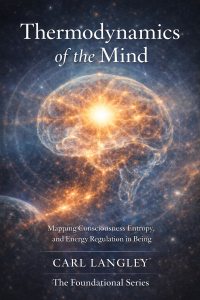
The field-based psychology Series is the root system of the library. It sets out the basic language, distinctions, and models that everything else builds upon — so later volumes can go faster without losing clarity. It’s written for readers who want a grounded map: what coherence is, how it degrades, how it can be rebuilt, and how to think about mind, meaning, and systems without reducing everything to a single lens.
This series doesn’t ask for belief. It offers a structured way of seeing: clear definitions, repeatable frameworks, and practical orientation that can be tested against real experience.
A shared vocabulary: baseline terms and distinctions used across the wider catalogue, so ideas stay consistent as the work scales.
First-principles framing: coherent “starting assumptions” drawn from science, philosophy, and systems thinking — without pretending any one discipline is the whole story.
Maps for coherence across scale: from individual self-regulation, to relationships and groups, to organisations and social systems.
Models you can reuse: frameworks for noticing drift, identifying leverage points, and restoring integration when things fragment.
A stable entry point: ideal if you want to understand the architecture of the work before moving into specialised series.
Auditism is the reflective art of sensing, mapping, and nurturing coherence within the fields we inhabit — personal, relational, organisational, societal, and over time. It emphasises responsibility without domination, repair without control, and practical language for seeing what’s happening and responding with proportion.
A complete series across scale: personal clarity, relational dynamics, collective systems, society as circuit, crisis & repair, ethical fieldwork, and continuity.
Core models and tools: the Coherence Cycle, Psycho-Thermodynamic Framework, and Field Audit Methodology
(Sense → Map → Reflect → Intervene → Integrate).
Designed for real contexts: individuals, practitioners, facilitators, educators, leaders, and changemakers working where relationship, power, rhythm, and meaning meet.
The Frontier Series sits where technology, philosophy, and field-based thinking meet. It explores how intelligence behaves in complex environments — especially when humans, organisations, and machine systems start to co-evolve. The aim is not hype or prediction, but usable orientation: how to think clearly, act responsibly, and build systems that stay coherent under pressure.
Coherent intelligence at the frontier: what “good judgement” looks like when systems become faster, more networked, and less predictable.
Governance and field stewardship: how to design decision-making, incentives, and safeguards that reduce drift and capture.
Scaling laws and system dynamics: how patterns change as teams, platforms, and networks grow — and what breaks first.
Protocols for exit and repair: how to disengage cleanly, recover coherence, and rebuild without denial or collapse.
Models you can apply: simple frameworks for mapping risk, responsibility, agency, and alignment in real contexts.
The Life Skills Series is the most directly usable part of the library: short, applicable frameworks for day-to-day life. It focuses on the “human basics” that quietly shape everything else — attention, emotional regulation, boundaries, decision-making, conflict navigation, habit formation, and sustainable self-care — without turning life into a performance or a productivity project.
Everyday tools that actually translate: simple models you can apply in real moments, not just in theory.
Self-regulation and steadiness: workable approaches to stress, overwhelm, rumination, and reactive loops.
Communication and boundaries: clearer language, cleaner agreements, fewer silent contracts.
Resilience through grounding: stability built through repeatable practices, not motivational intensity.
Designed for real contexts: personal, home life, relationships, work, health routines, and transitions.
The Training Series translates the core ideas of coherence into lived pedagogy, facilitation, and ritual practice. It is written for those who are not only studying the field, but working within it — as practitioners, teachers, guides, and stewards of shared spaces.
These books focus on how coherence is transmitted, not merely understood: through presence, structure, rhythm, symbol, and relational attunement.
Key themes across the series include:
Practising coherence as an embodied discipline, not an abstract concept
Teaching and facilitation grounded in clarity, safety, and non-domination
Holding the field in group settings, learning environments, and communal work
Ritual, expression, and symbolic practice as tools for integration rather than performance
Ethical stewardship of influence, power, and responsibility in teaching roles
The Training Series sits between understanding and action. It supports those who are stepping into roles where their inner coherence directly shapes others’ experience — whether in education, wellbeing, community work, therapy-adjacent practice, or informal leadership.
These books cultivate discernment, timing, and sensitivity — the subtle skills required to work with living systems rather than impose upon them.
This is training not as instruction, but as attunement.
These books sit alongside the larger series as individual works within the wider library. Each one stands on its own, with its own clear thread and purpose, while remaining consistent with the wider body of work in tone, depth, and orientation. This section includes titles such as Field Ethics, The Field and the Flow, Forest School Leadership, and Beyond the Consciousness Field.
Focused works: each book takes one subject and follows it through properly in a complete, self-contained form.
Broad range: the section includes philosophical, practical, educational, and exploratory works, depending on the title.
Consistent voice: clear, systems-aware, reflective, and non-dogmatic throughout.
Flexible entry points: readers can begin with the subject that most interests them and follow outward into the wider library if they wish.
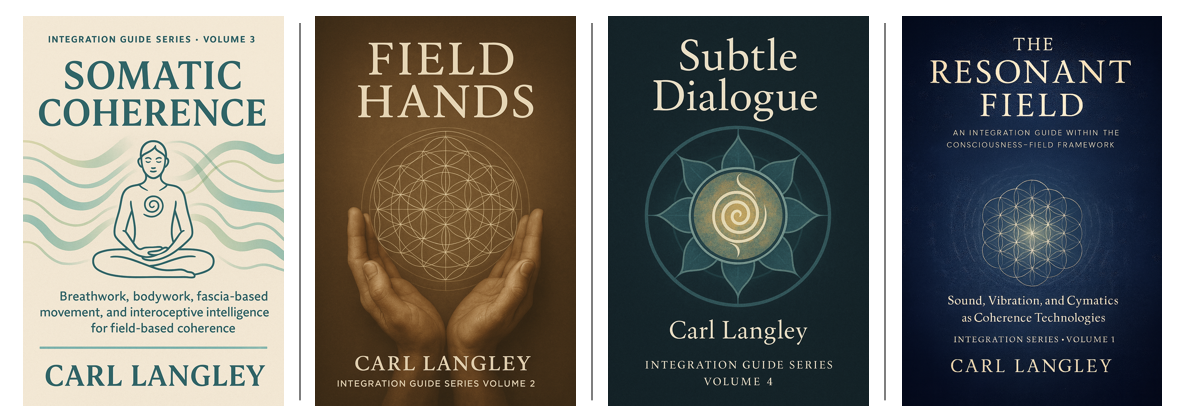
The Integration Guides are designed to enhance existing practice. They add context, structure, and a shared language for sense-making — helping concepts land in bodies, relationships, groups, and systems over time. Rather than replacing established approaches, they offer ways to clarify what’s happening, pace what’s possible, and support responsible integration in lived settings.
Modality-friendly: built to sit alongside counselling, coaching, education, facilitation, wellbeing work, leadership development, and other frameworks — adding coherence without competing for ownership.
Designed for delivery: useful for sessions, groups, classrooms, workshops, and one-to-one work.
Practice-aware: attentive to context, pacing, safety, consent, and what’s realistic day-to-day.
Modular tools: prompts, structures, and maps you can use in parts, revisit over time, and adapt to different populations and environments.
Cross-linked: draws on multiple ideas across the wider library where helpful, without assuming a single path or belief.
These guides aren’t prescriptions. They’re orientation tools — supporting clear thinking, grounded practice, and responsible application, while leaving practitioners free to work in the modality and style that fits their clients, communities, or classrooms.