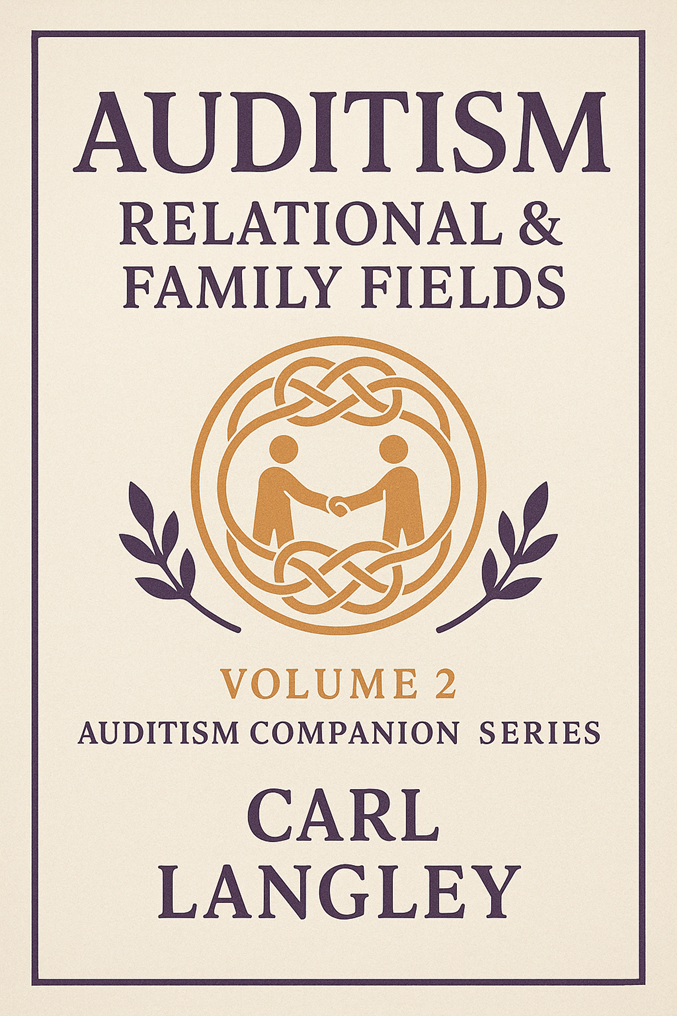
Auditism Vol2 Relational And Family Fields 1

Auditism Vol II — Relational & Family Fields

A practical field discipline for trust, rhythm, repair, and mutual growth in the relationships that matter most.

Relational and family coherence forms the bridge between personal clarity and collective renewal. This volume explores how coherence — and its disruption — shows up in partnership, friendship, and family life, and how resonance, rupture, and repair can be navigated without blame, control, or performance.

It offers grounded tools for sustaining trust, emotional intelligence, and integrity across bonds where interdependence is real.

What this book helps with

  • Understanding relationships as shared fields: how tone, rhythm, and behaviour co-create outcomes
  • Improving communication and truth-telling without escalation, blame, or withdrawal
  • Building trust and safety through consistency, consent, and clear boundaries
  • Navigating conflict as a field event (patterns, roles, feedback loops) rather than a character flaw
  • Strengthening repair capacity: rupture → recalibration → integration, without forcing premature harmony
  • Recognising family and relational roles (e.g., scapegoat/golden child dynamics) and reducing their grip
  • Handling separation, endings, and life transitions with clean closure and reduced residue
  • Developing ongoing relational stewardship: practices that support thriving, not just crisis response

Sample Passage


Every relationship — whether romantic, platonic, familial, or professional — is a living feedback loop. It forms and reforms itself in real time through micro-signals of presence, attention, tone, gesture, rhythm, and resonance. In this chapter, we explore the principle of coherence in dyadic relationships, where two beings co-generate a shared field that can either harmonise or destabilise depending on their attunement.

Coherence here does not mean sameness or perpetual agreement. It refers to the rhythmic synchronisation of difference — a capacity to remain distinct while being in resonant relationship. This is not about fixing another or becoming enmeshed, but about stabilising the field between.

Drawing on the principles of The Coherent Mind and Thermodynamics of the Mind, we understand relational breakdown not as personal failure but as field entropy. When stress, misunderstanding, or emotional charge accumulates without discharge or reorganisation, the relational field becomes noisy — communication degrades, coherence drops, and subtle signals become distorted or missed.

Auditism Vol2 Relational And Family Fields 1

What's inside

  • Understanding relationships as shared fields shaped by tone, rhythm, attention, and feedback
  • Communicating more cleanly: truth-telling without escalation, blame, or shutdown
  • Building trust and safety through consent, consistency, and clear boundaries
  • Recognising repeating relational loops (pursue/withdraw, criticise/appease, fix/avoid) and shifting them
  • Increasing repair capacity after rupture: recalibration, apology, reconnection, integration
  • Navigating family dynamics and roles (e.g., scapegoat/golden child patterns) with more clarity and less reactivity
  • Handling separation, endings, and life transitions with clean closure and reduced residue
  • Developing relational stewardship practices that support thriving over time, not just crisis response
Auditism Vol2 Relational And Family Fields 1

Sample Passage


The field itself becomes dysregulated — tense, contracted, less permeable. Communication distorts. Empathy may vanish. Understanding becomes obscured, not just by disagreement, but by disorientation. What we believe we know of the other may no longer match their intention — and vice versa. We may find ourselves speaking past one another, unable to hear or be heard.

What was once a shared space now feels separate, even adversarial.

This rupture is not an end point — it is a signal. Something in the field needs tending. And when approached with care, even painful ruptures can open the door to deeper coherence than was previously possible.

When rupture is not seen, named, or tended to, it often gives rise to self-reinforcing cycles — reactive patterns that deepen fragmentation and obscure the possibility of repair. These cycles are not signs of failure or malice; they are adaptive responses shaped by fear, hurt, and nervous system overload.

Who it’s for
  • Readers who want a disciplined, non-dogmatic approach to relationships and family dynamics
  • Partners, friends, and family members who want better coherence without blame, control, or performance
  • People navigating conflict, disconnection, repair, or recurring relational loops
  • Practitioners (counselling, coaching, facilitation, education, care) working with relational fields
  • Anyone living inside family systems, co-parenting, blended families, or long-term bonds
  • Those who want to build thriving, resilient relationships, not just “fix problems”

Use this volume as a relational calibration manual. Read once for orientation, then bring one real relationship or family pattern to the method. Observe the field (tone, pacing, roles, feedback loops), map what repeats, and make small changes that reduce distortion and increase safety. The aim is not perfect harmony; it is a workable, truthful field where difference can be held without collapse.

  • Dyad lens: choose one relationship and track the field for a week (tone, rhythm, recurring triggers, repair points)
  • Weekly relational audit: run Sense → Map → Reflect → Act → Integrate on one loop (e.g., pursue/withdraw)
  • Repair practice: use the rupture/repair chapters after conflict; debrief what actually happened and integrate
  • Family role mapping: map roles and patterns (who carries what, who avoids what) and test one boundary shift
  • Transition support: use the separation/crisis chapters during change (moves, grief, new relationships, co-parenting)
  • Practitioner use: pull one chapter theme to frame sessions, then review outcomes as field dynamics rather than blame

How it connects

What to read next

Auditism Volume II: Relational & Family Fields is the bridge volume in the series. It takes the personal clarity skills from Volume I (sensing accurately, mapping patterns, reducing bias and narrative capture) and applies them to the shared field between people — where tone, rhythm, roles, and feedback loops shape what becomes possible.

It also prepares the reader for the later, larger-scale books by training the same discipline in a more complex unit: not “me”, but us. When you can hold difference, repair rupture, and steward boundaries in relationship, the same method scales naturally into groups, organisations, and societal systems.

  • Auditism: The Reflective Art of Coherence — if you want the anchor text: ethos, safeguards, and the full method in one place
  • Auditism Volume I: Personal Clarity & Coherence — if you want to strengthen inner stability, rhythm, and self-auditing alongside relational work
  • Auditism Volume III: Collective Auditing & Systemic Coherence — if you want to scale the same method into groups, organisations, culture, and governance
  • Thermodynamics of the Mind — if you want a complementary “mechanics” lens for stress, load, rhythm, stability, and recovery in relational systems
Auditism Vol2 Relational And Family Fields 1

Where to buy this book

Availability details will appear here shortly, including:

Release date

Formats (ebook / paperback / hardback, where applicable)

Where to buy (direct + retailers)

Scroll to Top