The Patterned Mind 1

The Patterned Mind

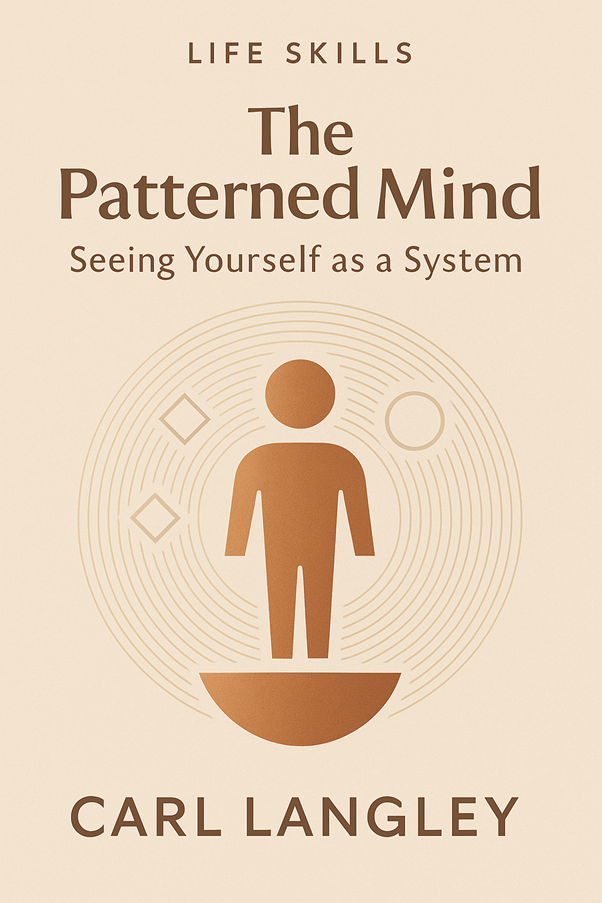
A calm, practical guide to understanding your thoughts, emotions, energy, and relationships as patterns you can read, refine, and redesign.

Your mind is not random — it is a living system of rhythms, feedback loops, signals, and resets. This book helps you build “system literacy”: noticing what tips you into overload, what restores you fastest, and how to create stable routines that support focus and wellbeing. Each chapter follows a predictable rhythm (concept, example, why it matters, practice, reflection), so you can read straight through or dip in when you need a reset, a clearer lens, or a better pattern to live by.

What this book helps with

  • Understanding your mind as a living system (not a problem to fix).
  • Spotting your repeat loops: triggers → reactions → outcomes.
  • Recognising overload early (entropy) and restoring order without shame.
  • Building stabilising rhythms and routines that make life feel safer and easier.
  • Regulating stress through pattern-based resets (breath, movement, attention).
  • Managing energy, focus, and flow by working with your natural cycles.
  • Relating to others as fields: resonance, boundaries, and not absorbing everything.
  • Communicating with clarity and repair, so connection strengthens rather than frays.
Sample Passage


Your mind is not a collection of random thoughts. It is a system — a set of patterns that interact, repeat, and adapt. Just like a weather system has seasons and feedback loops, so does your mind. Thoughts, emotions, and actions are not isolated events but connected signals moving through the same field.

When you begin to see yourself as a system, you stop treating every feeling or reaction as separate. Instead, you see rhythm, cause, and feedback. You start to recognise patterns — what triggers them, how they peak, and how they can be guided back into balance.

Seeing yourself as a system means stepping back far enough to observe how your parts relate. You are the observer and the participant. You are both the system and its designer.

The Patterned Mind 1

What's inside

  • The patterned mind — seeing yourself as a system, not a problem to fix.
  • Systems thinking as self-knowledge — mapping feedback loops and repeating patterns.
  • Entropy and overload — recognising early signals and restoring order without shame.
  • Rhythms and routines — building anchors that create stability without rigidity.
  • Regulation through pattern — breath, movement, sound, and repeatable reset loops.
  • Energy, focus, and flow — working with your natural cycles to reduce waste and increase clarity.
  • Other people as fields — resonance, boundaries, and staying grounded around intensity.
  • Communication through clarity — presence, pacing, tone, and repairing misunderstandings fast.
  • Repair and resilience — rupture → repair as the real measure of strength.
  • Belonging in the pattern — connection without conformity; tuned diversity in groups.
  • Designing your own system — building a personal “field manual” for daily life.
  • Integration and reflection — weekly review loops, small adjustments, coherence as a practice.
The Patterned Mind 1

Sample Passage


Every system has limits. When information, emotion, or sensory input becomes too much to process, the system moves from order toward chaos. In physics, this is called entropy — the loss of organisation or clarity within a system. In life, it feels like confusion, exhaustion, or overwhelm.

Entropy is not failure; it is feedback. It shows that your system has reached a point of overload and is asking for regulation. The goal is not to eliminate entropy — that’s impossible — but to learn how to release it safely and restore coherence.

Seeing this balance as natural helps you respond intelligently rather than personally. Entropy happens to all living systems. What matters is how quickly and compassionately you return to order.

Who it’s for
  • Anyone who wants practical tools for clarity, calm, and resilience in daily life.
  • Readers who feel overloaded, scattered, or easily overwhelmed, and want a non-shaming way to recover order.
  • People who notice strong patterns, sensitivity, or deep focus, and want structure without restriction.
  • Those who want to understand their habits, triggers, and feedback loops without turning it into self-blame.
  • People who want steadier rhythms and routines that support energy, focus, and wellbeing.
  • Anyone wanting better relationships and communication through boundaries, resonance, and repair.

Read it slowly and use it like a manual for observation and gentle practice. Each chapter follows the same rhythm (concept → example → why it matters → practice → reflection), so you can go in order or dip into the chapter that matches what you’re facing. Apply one idea at a time, keep it simple, and let your own observations become the data that helps you refine your system.

  • Chapter rhythm mode: read one chapter, do the practice once, answer the reflection prompts, then repeat for a week.
  • Pattern mapping mode: track inputs → internal response → output → resulting input for one recurring loop.
  • Entropy reset mode: when early overload signs appear, run a short reset protocol (reduce input → release → reorder → restore rhythm).
  • Rhythm-building mode: choose three daily anchors (wake, midpoint pause, wind-down) and stabilise them for 14 days.
  • Field-awareness mode: before and after key interactions, check your baseline, notice resonance, and strengthen boundaries where needed.
  • Weekly integration mode: 10-minute review: what supported coherence, what challenged it, and one small adjustment for next week.

How it connects

What to read next

The Patterned Mind is Life Skills Series — Volume III, following Raising Resilient Minds and Building Resilient Mindsets. It takes the same core aim — practical coherence and resilience — and shifts the focus inward: system literacy. Instead of treating your inner life as a set of problems to fix, it teaches you to read patterns (inputs → responses → outputs → feedback), recognise entropy early, and build rhythm-based routines that stabilise energy, focus, and relationships. It also acts as a bridge between personal practice and relational practice: once you can regulate and map your own system, you can meet others with clearer boundaries, better communication, and faster repair.

  • Raising Resilient Minds — for the environmental/parenting side: shaping the field around children with steadiness and repair.
  • Building Resilient Mindsets — for adolescent-facing tools: agency, values, inner talk, pressure, and the digital field.
  • The Coherent Mind — for the deeper psychological framing behind coherence, regulation, and integration.
  • Thermodynamics of the Mind — for stress/entropy/recovery as an applied lens across daily life and systems.
  • Auditism – The Reflective Art of Coherence — for reflective auditing, boundary clarity, and repair across relationships and groups.
  • The Field and the Flow — for learning to “see” resonance, tone, rhythm, and field dynamics in real situations.
The Patterned Mind 1

Where to buy this book

Availability details will appear here shortly, including:

Release date

Formats (ebook / paperback / hardback, where applicable)

Where to buy (direct + retailers)

Scroll to Top