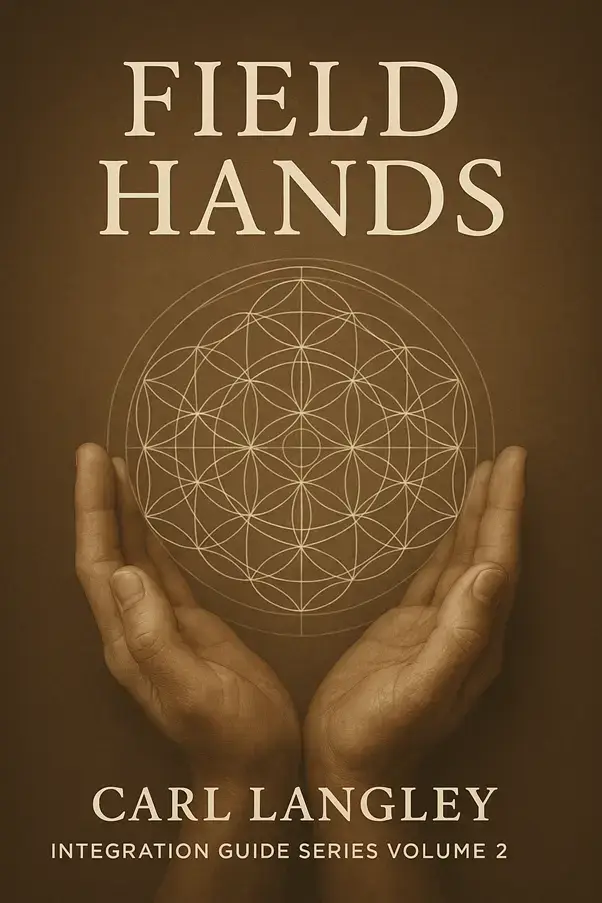
Field Hands 1

Field Hands

A practical guide to the hands as portals of resonance — using touch, presence, and palm-field techniques to support regulation, trust, and coherent healing.

Across cultures, hands have been used for blessing, protection, craft, and healing — not only as tools, but as extensions of heart and mind into the world. Field Hands explores the palms as instruments of coherence: how they can sense subtle shifts, stabilise nervous-system states, and participate in relational field dynamics through scanning, sensing, transmitting, and polarity-based balancing. You’ll find clear practices for self-hand work, partner support, group circles, energy hygiene, session design, and ethical touch — grounded in a simple ethos: functional alignment, sovereignty, and non-coercion.

What this book helps with

  • Using hands-on coherence practices for calming, grounding, and state regulation.
  • Developing palm-field sensitivity: scanning, sensing, and tracking subtle shifts.
  • Learning self-hand techniques for daily reset, sleep support, and emotional steadiness.
  • Understanding polarity and balancing in simple, practical terms (up/down, left/right, front/back).
  • Supporting others with safe partner work: presence, pacing, and clear boundaries.
  • Designing session structures for touch-based coherence work (open → sense → support → integrate → close).
  • Practising energy hygiene: not over-giving, not absorbing, and leaving the session clean.
  • Working ethically with touch: consent, safety, and respectful contact that strengthens trust.

Sample Passage


The hands have always held a special place in human life — not only as tools for survival, craft, and expression, but as extensions of the heart and mind into the world. Across cultures, hands have been symbols of blessing, protection, creation, and healing. They are the first medium through which we touch others, shape matter, and signal our intentions.

In this guide, Field Hands, we explore the hands as portals of resonance — instruments of coherence that both transmit and receive subtle information. The hands can regulate the nervous system, attune to relational fields, and participate in subtle energy exchanges that are foundational to practices like Reiki, polarity therapy, and auric sensing.

Between modern science and traditional wisdom lies a universal truth: the hands can act as conscious bridges between self, other, and field.

Field Hands 1

What's inside

  • Why hands matter — touch, presence, and palms as field interfaces.
  • The coherence-through-touch model — regulation, resonance, and relational safety.
  • Palm-field sensitivity — scanning, sensing, tracking, and calibrating perception.
  • Self-hand practices — grounding, calming, sleep support, and emotional reset routines.
  • Polarity and balance — practical maps (left/right, front/back, up/down) for coherence work.
  • Energy hygiene — boundaries, clearing, and leaving sessions clean (no over-giving, no absorbing).
  • Partner work basics — pacing, presence, consent, and safe contact.
  • Touch techniques — holding, hovering, compress/release, and gentle coherence transmission.
  • Session structure — open → assess → support → integrate → close, with simple templates.
  • Working with intensity — overwhelm, shutdown, agitation, and how to stabilise without forcing.
  • Group formats — circles, pair work, and coherent touch in shared spaces.
  • Ethics and stewardship — boundaries, responsibility, and when not to use touch.
Field Hands 1

Sample Passage


Scanning involves moving the palms slowly through the field — either around one’s own body or that of another — to detect areas of coherence or disruption. Hold your hand a few inches away from the body and move slowly, maintaining relaxed awareness. Practitioners often report temperature changes, tingling, magnetic-like resistance, or shifts in texture.

Sensing is the art of receiving subtle impressions through the palms without forcing interpretation. Instead of trying to “read” the field cognitively, allow impressions (warmth, flow, density) to register somatically. Naming what is sensed — gently, without imposition — helps build shared trust and accuracy.

Transmission is the intentional offering of coherence through the palms. Energy is not pushed but radiated — like warmth from a fire — and it always requires consent and clarity.

Who it’s for
  • Practitioners who want an embodied coherence tool using touch, hovering, and presence.
  • Readers seeking self-regulation practices that don’t rely on overthinking (hands as a direct anchor).
  • People supporting partners, friends, or family who want simple, safe ways to help without fixing or controlling.
  • Coaches, facilitators, and body-workers who want clear session structure for touch-based coherence work.
  • Anyone who feels highly sensitive to others and needs better boundaries and hygiene (not absorbing, not over-giving).
  • Group leaders who want pair-work and circle formats that are grounded and repeatable.

Start with self-hand practice first: learn how your own system responds before you work with anyone else. Then add palm-field sensitivity (scanning and sensing) and practise slowly, with light expectations and good notes. When you move into partner work, keep the structure simple: ask consent, settle the field, use short intervals, and close well. The point is not intensity — it’s steadiness, clarity, and clean endings.

  • Daily self-hand reset: 3–5 minutes of grounding holds + one minute of stillness to let the system settle.
  • Palm-scan mapping: once a day, scan around key areas (head, chest, abdomen) and note where the field feels dense/clear.
  • Partner support mode: a short “settle + hold + close” sequence with explicit consent and a clear time limit.
  • Polarity balancing mode: test left/right or front/back holds to notice what restores coherence fastest.
  • Hygiene and boundary mode: before/after every session: clear, release, re-centre, and return attention to your own body.
  • Session template mode: run a consistent arc: arrival → settle → assess → support → integrate → closure (with aftercare).

How it connects

What to read next

Field Hands sits in your Integration Guides as the touch-and-presence pathway into coherence practice. It takes the wider field model and translates it into direct, embodied methods: palm-field sensitivity, self-hand regulation, partner support, session structure, and clean boundaries. In the broader library it complements The Resonant Field (sound as a coherence lever) and Practicing the Field (coherence expressed in communal form), while drawing grounding and ethics from Practicing Coherence and Auditism. In short: it is where coherence becomes contact — not as force, but as attunement, pacing, and repair.

  • Practicing Coherence — for practitioner stance, pacing, session design, and working safely with states.
  • The Resonant Field — for sound-and-frequency methods that pair naturally with touch-based regulation.
  • Practicing the Field — for group formats, ritual structure, and communal coherence containers.
  • Auditism – The Reflective Art of Coherence — for boundaries, repair, and pattern-auditing in relationships and systems.
  • The Coherent Mind — for the deeper psychology of regulation, integration, and recoherence.
  • Thermodynamics of the Mind — for the pressure/entropy/recovery lens that explains why touch can stabilise and why aftercare matters.
Field Hands 1

Where to buy this book

Availability details will appear here shortly, including:

Release date

Formats (ebook / paperback / hardback, where applicable)

Where to buy (direct + retailers)

Scroll to Top