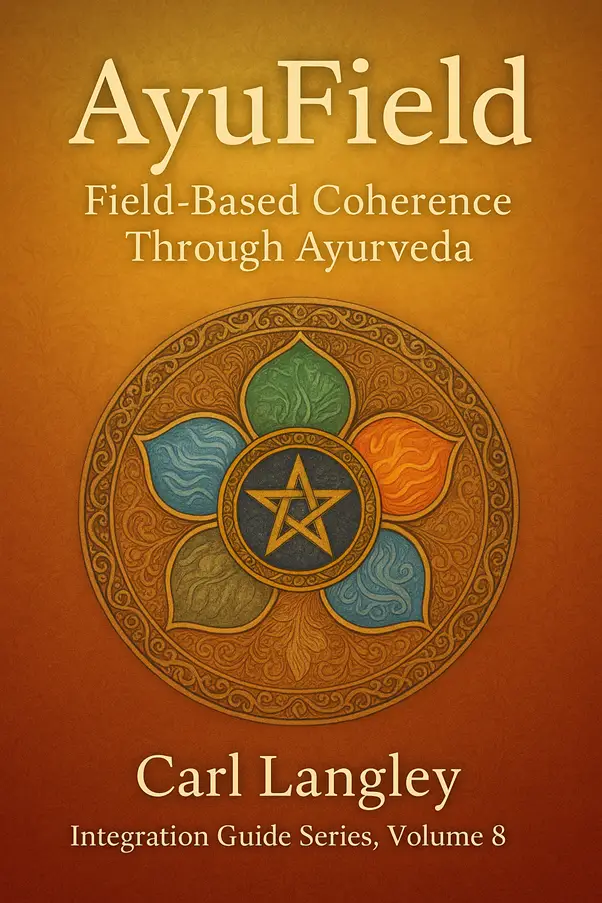
Ayufield

AyuField

A practical integration guide that reframes Ayurveda as coherence science — mapping elements, doshas, and daily rhythms as living field dynamics you can sense, tune, and stabilise.

Life unfolds in rhythms, and health follows rhythm when inner and outer cycles align. AyuField translates Ayurveda’s core grammar — the Panchamahabhuta, doshas, gunas, prana, nadis, and marma points — into a field-based language of resonance, feedback, and entropy, without turning it into a diagnostic label system. Expect clear principles, usable practices (dinacharya, pranayama, abhyanga, mantra), and protocol templates you can adapt across seasons, life stages, and real-world contexts — so coherence becomes a lived routine rather than a concept.

What this book helps with

  • Understanding Ayurveda as coherence practice: rhythm, balance, and field dynamics.
  • Identifying your dominant patterns of imbalance (Vata/Pitta/Kapha) without getting stuck in labels.
  • Building a steady daily rhythm (dinacharya) that stabilises energy, mood, and clarity.
  • Using simple breath and nervous-system tools to settle excess motion or agitation.
  • Working with the elements and qualities (gunas) as practical lenses for calibration.
  • Adapting routines for seasons and life stages (what changes, what stays steady).
  • Learning food, rest, and movement choices that support coherence rather than volatility.
  • Integrating classic practices: abhyanga, marma awareness, mantra, and grounding rituals.

Sample Passage


AyuField treats Ayurveda as a coherence science — a way of reading rhythm, pattern, and balance in living systems. It is not presented here as belief or culture-as-costume, and it is not a personality label system. It is a practical grammar for calibration: qualities (gunas), elements, and rhythms that you can sense in body, mood, appetite, sleep, and attention.

In this lens, “dosha” is not a fixed identity. It is a pattern of motion and organisation within the field. Vata expresses movement and variability; Pitta expresses heat and transformation; Kapha expresses structure and stability. When these patterns overrun their useful range, coherence declines — not because you are broken, but because the system is out of rhythm. The work is to restore rhythm with simple, repeatable adjustments.

Ayufield

What's inside

  • AyuField lens — Ayurveda as coherence science: rhythm, feedback, and balance.
  • The five elements — practical use of Earth/Water/Fire/Air/Ether as calibration lenses.
  • Doshas without labels — Vata/Pitta/Kapha as dynamic patterns, not fixed identity.
  • Gunas and qualities — how to read states (heavy/light, hot/cool, dry/oily, etc.).
  • Dinacharya — daily rhythm as medicine: anchors, routines, and real-world adaptation.
  • Seasonal coherence — ritucharya: what changes across seasons, what stays steady.
  • Food as field input — digestion, appetite, timing, and simple coherence-based choices.
  • Breath and prana — pranayama as regulation: settling motion, cooling heat, lifting inertia.
  • Abhyanga — oiling as nervous-system support and grounding ritual.
  • Marma awareness — key points as practical attention and self-care cues.
  • Mantra and sound — stabilising mind through repetition and resonance.
  • Protocols and templates — quick routines for Vata/Pitta/Kapha spikes + integration loops.
Ayufield

Sample Passage


One of Ayurveda’s most powerful contributions is its insistence on rhythm. Dinacharya — daily routine — is coherence training. The point is not to become perfect, but to give your system predictable anchors so it can regulate without constant effort.

Start small. Choose three anchors: a consistent wake time, a morning settle practice, and an evening downshift. Then stabilise them for two weeks. Layer gradually: hydration, tongue scraping, warm water, gentle movement, oil massage, breathwork, and a simple meal rhythm.

When Vata is high (scattered, anxious, restless), rhythm and warmth are medicine. When Pitta is high (irritable, intense, overheated), cooling, space, and reduction of stimulation are medicine. When Kapha is high (heavy, sluggish, stuck), mobilisation, lightness, and activation are medicine. Coherence comes from matching the day’s practices to the day’s field conditions.

Who it’s for
  • Readers who want Ayurveda in practical language: rhythm, balance, and daily life application.
  • People who feel scattered, overheated, or sluggish and want simple calibration tools that don’t rely on willpower.
  • Practitioners integrating Ayurveda into coaching/wellbeing work who want clear frameworks without dogma.
  • Anyone wanting to build steady routines (sleep, food timing, movement, breath) that support resilience.
  • Those interested in the elements and qualities as lenses for self-observation and adjustment.
  • People who want seasonal and life-stage adaptation: what to shift, what to keep stable.

Start with rhythm before complexity. Choose a small dinacharya you can actually keep (wake time + morning settle + evening downshift) and run it for two weeks. Then layer in one practice at a time — breath, warm water, movement, oiling, meal timing — and observe what changes in sleep, appetite, mood, and focus. Use the dosha and guna lenses as diagnostic hints, not identities: you’re learning to read conditions and respond proportionately.

  • 3-anchor dinacharya: stabilise wake time + morning settle + evening downshift for 14 days.
  • Dosha spike protocol: when Vata/Pitta/Kapha rises, apply the matching counter-quality for 24–48 hours.
  • Guna calibration: name the dominant quality (hot/cold, dry/oily, heavy/light) and choose one balancing input.
  • Seasonal switch: at each seasonal threshold, adjust one thing (food, sleep, movement, stimulation) rather than everything.
  • Abhyanga week: oil massage 3–5 times in a week to ground, settle, and support sleep.
  • Breath-as-medicine: use one pranayama for settling (Vata), one for cooling (Pitta), one for lifting (Kapha).

How it connects

What to read next

AyuField sits in your Integration Guides as the Ayurveda pathway into coherence practice — translating ancient rhythm-based wisdom into your field language of signal, balance, entropy, and restoration. It complements Somatic Coherence by giving daily-life protocols (routine, food timing, seasonal shifts) that keep the body regulated between deeper practices, and it pairs naturally with The Resonant Field (mantra/voice as stabilisers) and Nature in the Field (seasonal rhythm and ecological calibration). In the wider library, it supports the same aim found throughout: coherence as something lived — through rhythm, restraint, and repeatable practice — not something merely understood.

  • Somatic Coherence — for breath, grounding, fascia, and body-based regulation that deepens Ayurveda practice.
  • Nature in the Field — for seasonal attunement and rhythm with land, weather, and the biosphere.
  • The Resonant Field — for mantra, toning, and sound as practical stabilisers of mind and state.
  • Practicing Coherence — for practitioner stance, pacing, and teaching frameworks if you deliver this work to others.
  • Thermodynamics of the Mind — for the pressure/entropy/recovery lens that mirrors Ayurvedic balance and overload.
  • The Field and the Flow — for perceiving tone, rhythm, and resonance across environments and relationships.
Ayufield

Where to buy this book

Availability details will appear here shortly, including:

Release date

Formats (ebook / paperback / hardback, where applicable)

Where to buy (direct + retailers)

Scroll to Top