Consciousness Beyond the Brain
Most people today inherit a fairly standard assumption about consciousness: the brain produces it.
In that view, awareness is what the brain does. Thoughts, emotions, perception, memory, and the sense of self are all treated as outputs of neural activity. If the brain changes, consciousness changes. If the brain stops, consciousness ends. The model is tidy, familiar, and deeply embedded in modern culture.
There is good reason for that. The brain clearly matters. Injury, chemistry, sleep, trauma, development, and neurological change all affect the quality and structure of conscious experience. Any serious inquiry into mind must take biology seriously.
But taking biology seriously does not require reducing consciousness to biology alone.
That is where the question begins.
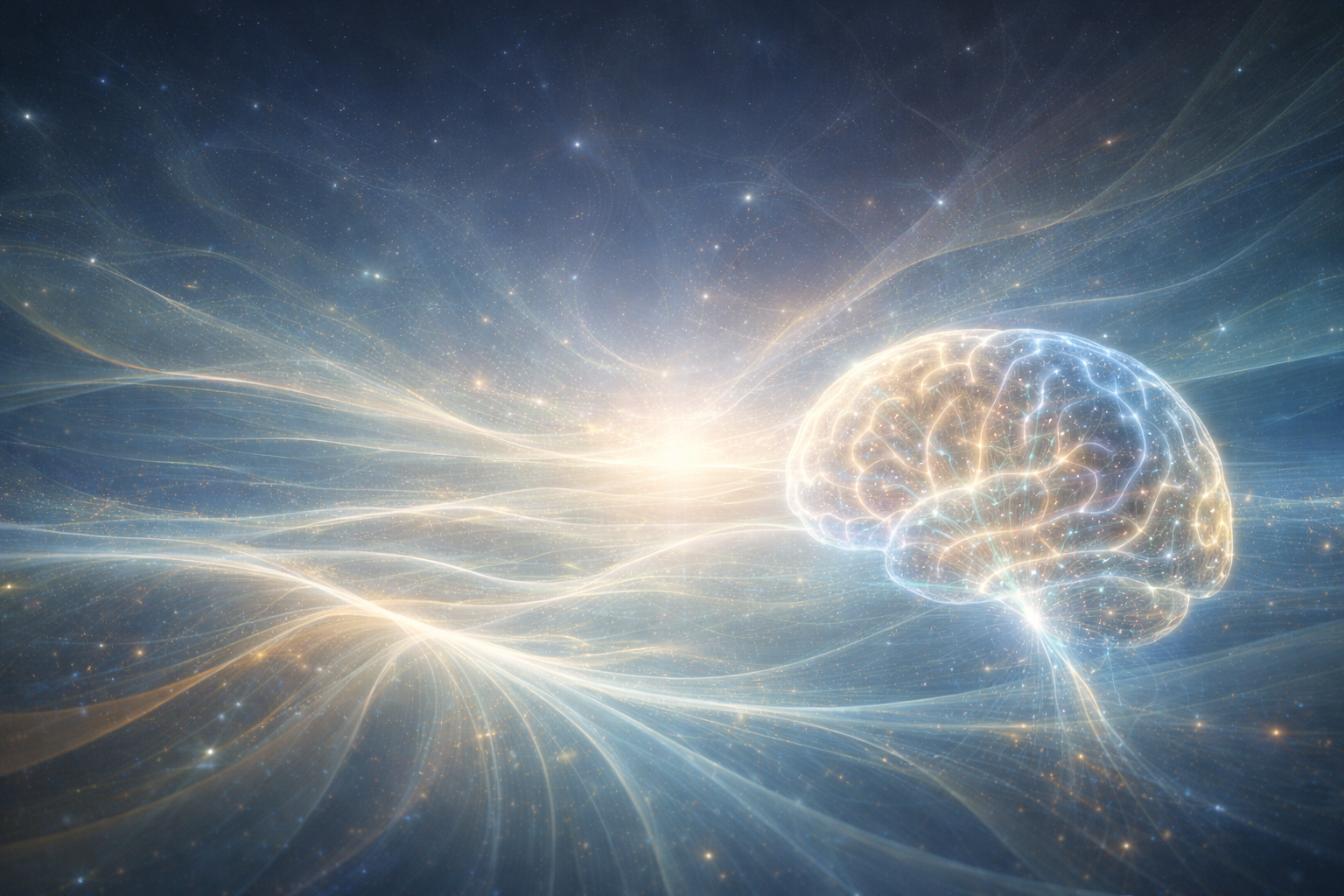
What if the brain is not the sole producer of consciousness, but an organ of mediation? What if awareness is not simply generated inside the skull, but arises through a more complex relationship between the brain, the body, and a wider field of information, energy, and resonance?
This is not a new question. It has appeared, in different forms, across philosophy, contemplative traditions, and psychology for a very long time. What changes from era to era is the language used to approach it.
Today, the standard materialist model remains powerful, but it still leaves a profound mystery unresolved: how does subjective experience arise at all? How do electrochemical events become the felt reality of colour, sound, grief, love, memory, meaning, or the sense of being a self? Correlations between brain states and experience are real and important, but correlation is not the same as explanation.
This gap is sometimes called the hard problem of consciousness, but the issue is older and wider than the phrase itself. The basic difficulty is simple: even if we map every neural event with extraordinary precision, we still have not fully explained why there is experience in the first place.
That does not prove that consciousness exists outside the brain. But it does suggest that the question remains open.
One alternative is to think of consciousness less as a product and more as a process of relationship.
In that view, the brain is not dismissed. It remains essential. But it may function less like a generator and more like an interface, receiver, modulator, translator, or tuning organ. Consciousness would then be understood not as a sealed internal secretion of neural matter, but as something that emerges through coherence between organism and field.
That language can sound unusual at first, but it may be more intuitive than it appears.
We already know that human beings are not closed systems. We are continuously shaped by rhythms, environments, relationships, chemistry, memory, attention, culture, and embodied state. The nervous system is not a detached control centre floating above life. It is in constant exchange with breath, posture, gut, hormones, electromagnetic activity, sensory input, and relational context. Even before we reach more speculative territory, the self is already far more distributed and relational than the everyday image of “a brain producing a person” suggests.
This is one reason I find a field-based perspective helpful.
A field, in this context, does not have to mean anything mystical or dogmatic. It can simply mean a distributed pattern of influence, relation, and information that shapes what becomes possible within a system. Once we accept that human beings participate in multiple overlapping fields — biological, emotional, relational, social, environmental, and perhaps more subtle forms besides — it becomes easier to ask whether consciousness might also be better understood in relational rather than purely local terms.
From this perspective, awareness may not be identical with the brain, even though the brain is one of its primary instruments.
That shift matters because it changes how we think about mind, healing, and identity.
If consciousness is only what the brain secretes, then much of human experience is reduced to mechanism. Meaning becomes a side effect. Subjectivity becomes an accident. The felt life of a person becomes secondary to the machinery that supposedly produces it.
If, however, consciousness is more fundamental or more widely distributed than that, then the person is not simply a machine with private mental outputs. They are a living node within a larger field of relationship and participation. Mind becomes something that happens through us, not only inside us.
That idea can be overdone, of course. It is easy to become vague or grandiose around such questions. So it is worth being disciplined.
To say that consciousness may extend beyond the brain is not to deny neuroscience. It is not to reject medicine, psychology, or biology. It is not to claim certainty where there is still mystery. And it is certainly not to abandon rigour in favour of fantasy.
It is simply to resist premature closure.
A healthy inquiry leaves room for both evidence and depth.
This matters practically, not just philosophically.
How we understand consciousness affects how we understand distress. If mind is only brain, then many experiences are automatically interpreted in highly reductive terms. But if mind is relational, embodied, and field-shaped, then phenomena such as trauma, intuition, resonance, emotional contagion, collective states, environmental effects, and the healing value of rhythm and presence start to make more sense within a larger frame.
The body becomes more than a vehicle. Relationship becomes more than social context. Environment becomes more than backdrop. Attention becomes more than a mental spotlight. Each becomes part of the architecture through which consciousness is shaped, stabilised, disrupted, or deepened.
This also changes the meaning of coherence.
If consciousness is relational, then coherence is not merely “brain optimisation”. It becomes the quality of alignment across the wider human system: attention, emotion, body, behaviour, memory, value, environment, and field participation. A more coherent person is not simply someone whose neurons are firing efficiently. They are someone whose inner and outer patterns are in more workable relationship.
That does not answer the full mystery of consciousness. But it does point us towards a more adequate psychology.
One of the reasons this question matters to me is that many people already feel, long before they can articulate it, that the standard picture is incomplete. They sense that awareness is not exhausted by neural description, even while recognising that the brain is deeply involved. They notice that meaning, presence, relationship, and felt reality cannot be reduced so easily to mechanism without something important being lost.
That intuition should not be treated as proof.
But neither should it be dismissed merely because it is difficult to quantify.
A mature approach to consciousness should be able to hold both humility and openness. Humility, because we do not yet fully understand mind. Openness, because our current models may still be partial.
In that spirit, I find it useful to hold a working proposition:
the brain matters profoundly, but consciousness may not be reducible to the brain alone.
It may instead arise through a deeper interplay between biology, awareness, embodied life, and a wider field of relation and information.
That proposition cannot simply be asserted. It must be explored, tested, refined, challenged, and lived against experience. But it opens a richer line of inquiry than the assumption that the question has already been settled.
And perhaps that is the real point.
Not to replace one certainty with another, but to make room for better questions.
What is consciousness?
What is the brain actually doing?
What is the body’s role in awareness?
How do relationship and environment shape mind?
What forms of coherence make awareness clearer, steadier, or more integrated?
What if consciousness is not trapped inside us, but moves through us?
These are not merely abstract questions. They shape how we understand ourselves, each other, and reality itself.
For me, that is where the inquiry begins.
Not with a fixed doctrine, but with a refusal to reduce the mystery too quickly.
The brain is clearly part of consciousness.
But it may not be the whole story.