I have published a new conceptual paper:
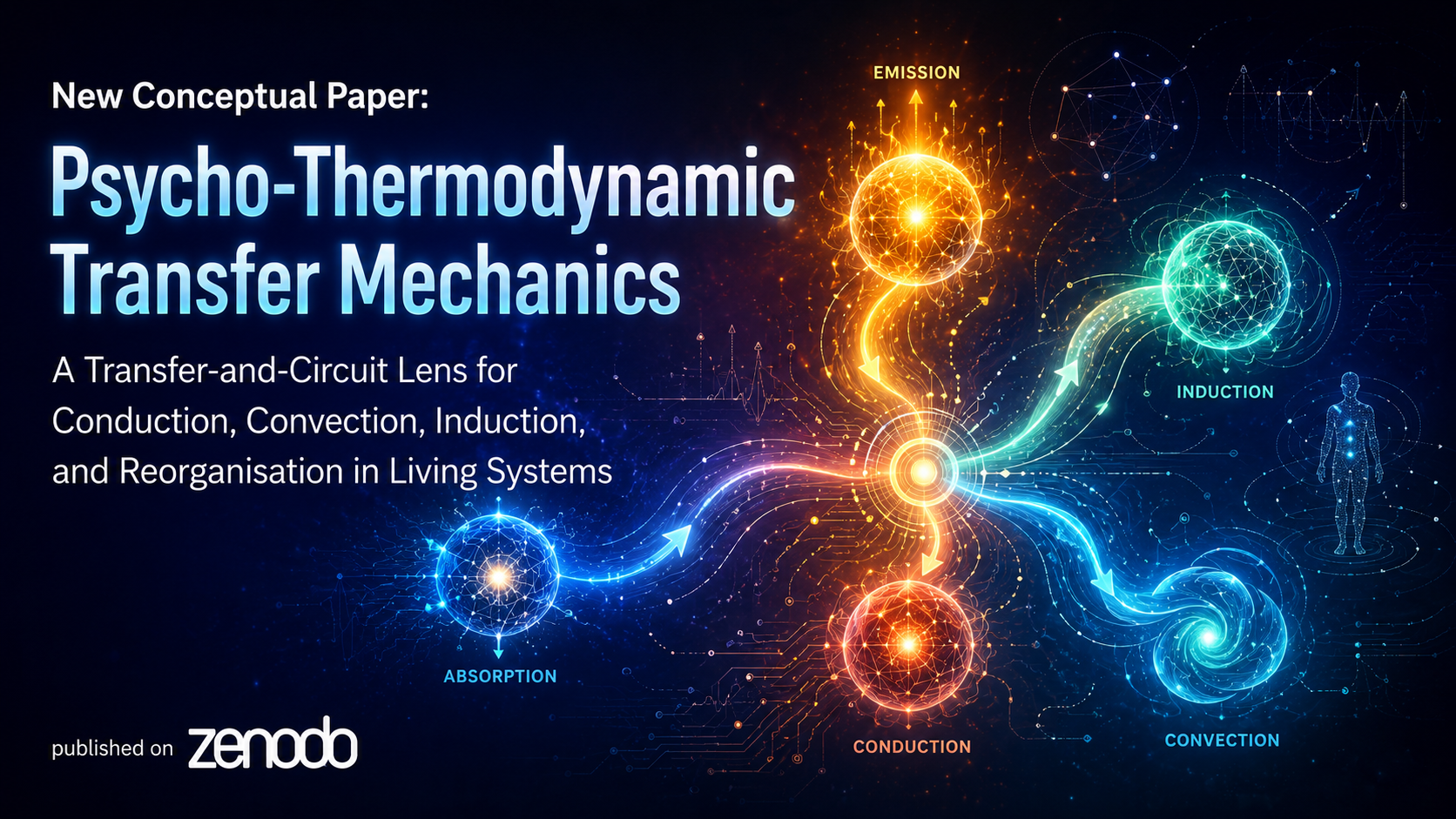
Psycho-Thermodynamic Transfer Mechanics: Conduction, Convection, Induction, Circuit Accounting, and Absorption-Emission Dynamics in Living Systems
DOI: https://doi.org/10.5281/zenodo.20804723
This paper develops a transfer-and-circuit lens for understanding how state moves through people, relationships, classrooms, organisations, and cultures.
The central idea is simple: many forms of distress, escalation, burnout, rupture, and recovery can be understood not only as individual problems, but as patterns of state movement within living systems.
Rather than asking only “what is wrong with this person?”, the paper invites a different set of questions:
What is being conducted between people?
What is circulating through the system?
Where is resistance generating heat?
What is being stored as unresolved charge?
What is being emitted into the wider field?
Is this a first-order regulation problem, or does the circuit itself need redesign?
The aim is not to reduce psychology to physics, or to replace established clinical, educational, organisational, or systemic models. Instead, the paper offers a disciplined, non-pathologising grammar for mapping load, rhythm, feedback, stored charge, recovery capacity, and reorganisation need across living systems.
In this framework, concepts such as conduction, convection, induction, resistance, capacitance, hysteresis, and Kirchhoff-style circuit accounting are used as bounded analogies. They are not claims that human beings are machines or circuits. They are practical tools for seeing how emotional, relational, and systemic states move, accumulate, transform, and sometimes become stuck.
The paper also distinguishes between two forms of change:
First-order change regulates the current circuit. It may reduce heat, restore rhythm, improve grounding, or stabilise immediate distress.
Second-order change redesigns the circuit itself. It asks why the same pattern keeps being produced, and what deeper reorganisation may be needed.
This includes:
- claim-discipline guardrails
- operationalisation pathways
- worked examples for relational, school, and organisational settings
- a simple 0–3 field audit coding scale for early practitioner and research use
The paper is intended for therapists, educators, coaches, organisational practitioners, researchers, and anyone interested in coherence, systems thinking, field-based psychology, and non-pathologising approaches to human distress and repair.
As always, this is offered as a way, not the way: a practical lens for clearer seeing, better timing, and more proportionate repair.
Read the paper here: